
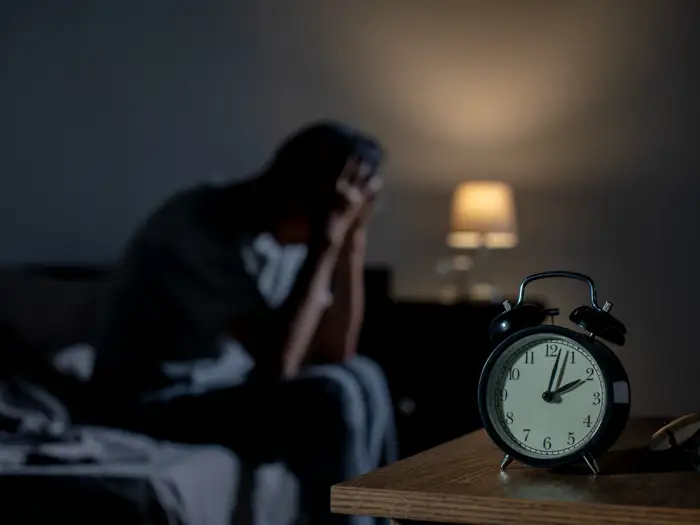
Psychophysiological insomnia is insomnia kept going by a heightened state of alertness and by learned habits that link the bed with being awake.1 It often starts during a stressful stretch and continues long after the stress has passed.5,6 Today it is diagnosed as chronic insomnia disorder,2 and the recommended first treatment is cognitive behavioral therapy for insomnia (CBT-I).4
In this article (13 sections)
The guidance in this article is for adults. Insomnia in children and teens needs its own evaluation, with a parent or guardian involved.
What psychophysiological insomnia means
The name joins two parts. “Psycho” refers to the thoughts and worry that keep you awake. “Physiological” refers to the body’s alert state, such as tension that won’t let you relax. The older sleep classification described it as heightened arousal plus “learned sleep preventing associations”: over time, the bed and the bedroom become cues for being awake instead of cues for sleep.1
A typical night can look like this. You are tired all evening, even nodding off on the couch, then wide awake as soon as you get into bed. Your mind turns to the day, to tomorrow and to how little sleep you will get. The more you focus on sleep, the further away it feels.1
What the term means today
You will still see “psychophysiological insomnia” in articles and older records, but it is no longer a separate diagnosis. The current edition of the sleep-disorder classification used by sleep specialists collapses the earlier insomnia diagnoses into a single chronic insomnia disorder.2 The DSM-5, the manual psychiatrists use, also places insomnia diagnoses in a single category.3
Chronic insomnia means trouble falling asleep, staying asleep or waking earlier than you want, despite enough opportunity to sleep, at least three times a week for at least three months.4
The change also ended the old split between “primary” insomnia and insomnia that is “secondary” to another condition. Insomnia overlaps with many disorders, and as the classification’s editor put it, telling cause from effect is difficult.3 In practice, that means insomnia can be recognized and treated in its own right, even when anxiety or depression is also present.
Signs that point to this pattern
The older criteria described specific clues that sleep has become conditioned, or learned:1
- A lot of focus on sleep, and anxiety about it. Sleep becomes something to worry about and plan around.
- Trouble falling asleep at bedtime, but not at other times. You can’t sleep in bed when you mean to, yet you doze off without meaning to while reading or watching TV.
- Sleeping better away from home. A hotel or a friend’s couch can bring easier sleep, because it doesn’t carry the same cues as your own bed.
- A busy mind in bed. Thoughts that intrude, or that you can’t switch off.
- A tense body. Physical tension that keeps you from relaxing.
Watching the clock and worrying about getting enough sleep can raise the risk of insomnia or make it worse.6
| More like psychophysiological insomnia | Worth checking for something else |
|---|---|
| You sleep better away from your own bed1 | Loud snoring, breathing that starts and stops, or gasping for air (signs of sleep apnea)10 |
| You doze off unplanned in the evening, then lie awake in bed1 | Low mood or loss of interest along with the sleep problem; depression often disrupts sleep5 |
| Your worry is mostly about sleep itself1,6 | Ongoing anxiety about many things, which may need its own treatment5 |
| It began in a stressful stretch and outlasted it5 | It began with a new medicine, or with changes in caffeine, alcohol or other substances7 |
The table is a way to organize what you notice, not a way to diagnose yourself. An evaluation sorts out which pattern fits.
How a few bad nights become chronic insomnia
Short-term insomnia often follows a stressful event, such as a job loss or a death in the family, and it is usually brief.5 For some people it doesn’t fade. Insomnia, whatever started it, can persist well beyond the events that set it off.5
The way it keeps going is often the effort to fix it. People spend hours in bed brooding about being awake, and the anxiety builds before bedtime.5 Going to bed earlier, sleeping in or napping can work against sleep; a regular wake-up time and avoiding naps are part of standard advice.5,8 Each night spent awake in bed adds to the link between the bed and being alert, which is the learned part of psychophysiological insomnia.1,8
How insomnia connects with anxiety and depression
Insomnia and mental health often travel together. About 40% of people with chronic insomnia have a major psychiatric disorder, most often a mood disorder, and at least 80% of people with major depression report sleep problems or daytime sleepiness.5
That is why the older diagnosis of psychophysiological insomnia required that the sleep problem not be better explained by another condition, including a mental health condition.1 A psychiatric evaluation looks at both: whether anxiety or depression is part of the picture, and whether insomnia has taken on a life of its own. Persistent anxiety may need its own treatment.5
How insomnia is diagnosed
Insomnia is diagnosed mostly from what you describe. A provider asks how often the problem happens and how long it has lasted, when you go to bed and wake up on work days and days off, how long it takes to fall asleep, how often you wake, and how you feel during the day.7 They also ask about health conditions, medicines, and caffeine, nicotine, alcohol or other substances.7
A physical exam can look for other medical problems that affect sleep. Blood tests can check for thyroid problems or other conditions, and a sleep study can check for other sleep disorders such as sleep apnea, circadian rhythm disorders or narcolepsy.7
Keep a sleep diary for one to two weeks
A sleep diary kept for one to two weeks before a visit gives your provider a clear picture.7 Each day, note:7
- Bedtime and wake-up time, and any naps.
- How sleepy you felt during the day.
- Caffeine and alcohol, and when.
- Exercise, and when.
It can also help to add a line on the clues above: whether you slept differently away from home, whether you dozed off unplanned in the evening, and what was on your mind in bed.1
CBT-I: the recommended first treatment
The American Academy of Sleep Medicine (AASM) calls cognitive behavioral therapy for insomnia the first-line recommended treatment for chronic insomnia.4 Its patient guide says CBT-I should be used to treat almost all adults with chronic insomnia.9
CBT-I is a structured treatment, usually six to eight weeks long,8 or typically four to eight sessions.9 It combines several parts:8
- Stimulus control, which rebuilds the link between bed and sleep: go to bed only when sleepy, get up if you can’t sleep, and use the bed only for sleep and sex.
- Sleep restriction, which limits time in bed to a set window and widens it gradually as sleep improves.
- Cognitive therapy, which works on anxiety about not being able to sleep.
- Relaxation training, which helps you wind down.
- Sleep education about healthy sleep habits.
The plan is tailored to each person’s symptoms.4 CBT-I can be done by a doctor, nurse or therapist,8 and it can work when delivered in person, by telehealth or through an app.9 Ask your provider which way of getting it fits you.
Why sleep habits alone usually aren’t enough
Basic sleep habits matter: a regular schedule, a cool, quiet and dark bedroom, and no caffeine, nicotine or alcohol close to bedtime.8 The AASM guide notes that most people with chronic insomnia need more than basic steps such as cutting caffeine or changing a mattress.9 Sleep hygiene instructions given alone are not considered helpful as a treatment for this kind of insomnia, which is why CBT-I pairs them with the behavioral steps above.1
Where medication fits
Prescription medicines are sometimes part of an insomnia plan. Some are meant for short-term use and others for longer-term use.8 Treatment that combines cognitive behavioral strategies with medication can help, and the effects of the behavioral strategies last well after treatment ends.5 If a medicine is considered, your provider explains why it might help, and follow-up visits check whether it is working and still needed.
When it may be something else
Some sleep problems need a sleep specialist rather than, or as well as, insomnia treatment. Loud, frequent snoring, breathing that starts and stops during sleep, gasping for air, and daytime sleepiness can be signs of sleep apnea.10 If these sound familiar, talk with your primary care provider about a sleep evaluation.
When to get an evaluation
It is worth talking with a professional if:
For more on how sleep problems are evaluated and treated at the practice, see Sleep Problems & Insomnia: evaluation and treatment for ages 5 to 65 ›
Care at Integral Psychiatric Care
Integral Psychiatric Care is an outpatient psychiatry practice in Reston, Virginia, for children, teens and adults ages 5 through 65. Your provider looks at sleep together with mood, worry and focus. Care can include sleep-habit guidance, treatment of anxiety or depression that is part of the picture, and medication when it fits.
Every new patient starts with an initial psychiatric evaluation, in person in Reston or by video while you are in Virginia or Maryland. Video visits are limited to Virginia and Maryland because Sahar Zaidi, MD is licensed in Virginia and Maryland. A parent or guardian joins every visit for ages 5 to 17.
After you send a request, our intake team will reach out to talk through next steps and scheduling.
This article is for general education and is not a substitute for professional medical advice, diagnosis or treatment.
References 10 sources
- Perlis ML, Gehrman P. Psychophysiological Insomnia. In: Kushida CA, ed. Encyclopedia of Sleep. Elsevier; 2013:203–204.
- American Academy of Sleep Medicine. Psychiatric News examines changes to insomnia diagnoses in ICSD-3.
- Psychiatric News (American Psychiatric Association). Manual Updates Sleep Disorder Diagnoses. August 14, 2014.
- American Academy of Sleep Medicine. 12th annual Insomnia Awareness Night highlights chronic insomnia symptoms, treatment. June 20, 2025.
- Schwab RJ. Insomnia and Excessive Daytime Sleepiness (EDS). MSD Manual Professional Version, full review July 2026.
- National Heart, Lung, and Blood Institute. Insomnia: Causes and Risk Factors. Last updated March 24, 2022.
- National Heart, Lung, and Blood Institute. Insomnia: Diagnosis. Last updated March 24, 2022.
- National Heart, Lung, and Blood Institute. Insomnia: Treatment. Last updated March 24, 2022.
- American Academy of Sleep Medicine. A patient’s guide to understanding behavioral and psychological treatments for chronic insomnia disorder in adults. 2021.
- National Heart, Lung, and Blood Institute. Sleep Apnea: Symptoms. Last updated January 9, 2025.