
Medication, when it fits
Options include stimulant and non-stimulant medicines. Non-stimulants may be used when stimulants don’t suit. Starting involves adjusting the dose and checking side effects such as sleep and appetite.[5]
Attention & Focus (ADHD)
Medically reviewed by Sahar Zaidi, MD, double board-certified in adult and child & adolescent psychiatry · Reviewed October 10, 2026
For children, teens and adults ages 5 to 65
Trouble finishing tasks, losing track of time, feeling overwhelmed, or falling behind despite trying hard can sometimes be connected to ADHD.
Integral Psychiatric Care evaluates attention and focus concerns, including ADHD, in children, teens and adults ages 5 to 65 at its Reston, Virginia office and by video in Virginia and Maryland. Care starts with an initial psychiatric evaluation.
After you send a request, our intake team will reach out to talk through next steps and scheduling.
You don’t need an earlier diagnosis or test results to ask for an evaluation.


Double board-certified: Adult and Child & Adolescent Psychiatry
Washingtonian Top Doctor, Psychiatry, 2024 and 2025
What ADHD is
ADHD (attention-deficit/hyperactivity disorder) is a neurodevelopmental condition that affects attention, activity level and impulse control.[3]
It begins in childhood and often continues into adulthood. Clinicians describe three presentations: mostly inattentive, mostly hyperactive-impulsive, or combined. Some people still call ADHD “ADD”. It isn’t caused by laziness, a lack of intelligence or poor parenting.
Everyone loses focus sometimes. ADHD is a pattern that has lasted, shows up in more than one part of life, and gets in the way of school, work, home or relationships.
Trouble focusing is a symptom, not a diagnosis. Sleep problems, anxiety, depression, stress, learning differences, hearing or vision problems, and some health conditions or medicines can also make it hard to pay attention.
ADHD is more likely when the pattern started in childhood and shows up in more than one setting.[3] Sometimes the answer is ADHD, sometimes it’s something else, and sometimes it’s both.
A clear explanation for long-standing struggles, or a clear answer that something else is going on.
Sleep, anxiety, mood and learning differences can affect focus too. Treating the actual cause saves time and frustration.
A documented diagnosis can support requests for accommodations. Schools decide who qualifies for school plans.
If medication is considered, it starts from a full evaluation and continues with regular follow-up.
Signs by age
People rarely describe it as “ADHD”. They describe what it costs them: homework battles, unfinished work, being late, or feeling behind despite real effort. Choose an age group to see common signs.
At least six symptoms (five from age 17), lasting at least six months, with several present before age 12. They show up in two or more settings, such as home and school or work, get in the way of daily life, and aren’t better explained by another condition.[3] Recognizing these signs is a reason to ask, not a diagnosis.
How it’s diagnosed
There is no single test for ADHD. No blood test, brain scan or computer test can diagnose it on its own.[3] A diagnosis comes from a careful psychiatric evaluation, sometimes called an ADHD assessment.
Send a request or call 703-991-0564. Our intake team talks through what’s going on, your insurance and scheduling.
In person in Reston or by secure video. It covers the whole picture: history since childhood, how symptoms show up at home, school or work, health, sleep, mood and anxiety. Because ADHD shows up in more than one setting, information from more than one place helps: for children and teens, a parent’s view and school input such as report cards or teacher comments; for adults, old report cards or a family member’s input, once you give written permission (a release of information).[4]
Your provider looks at conditions that can look like ADHD, and at conditions that often come with it. Some do both.[4]
Your provider explains the findings in plain language. When the criteria are met, you receive a diagnosis and options you decide on together. If it isn’t ADHD, your provider explains what the evaluation found and discusses care for that, such as anxiety, mood or sleep, or other next steps.
You don’t need an earlier diagnosis or test results, and Integral Psychiatric Care doesn’t require a referral (some insurance plans do). If you have earlier reports, school notes or a list of medicines tried, you can upload them to your patient portal before your visit.
| Can look like ADHD | Often occur alongside ADHD |
|---|---|
| Sleep problems | Anxiety |
| Anxiety | Learning differences |
| Depression | Behavior problems |
| Learning differences | Sleep problems |
| Hearing or vision problems | Depression |
Is formal psychological testing needed? Not for most people. It may be suggested when a learning difference or another question needs a closer look. Your provider explains why and what’s involved before anything is arranged.
Treatment
Treatment is planned after the evaluation and talked through with you before anything starts. National guidelines give the starting point, and the plan is built around you or your child.
| Age | What guidelines recommend first |
|---|---|
| Age 5 | Behavior-focused parent training and classroom supports come first. Medication may be considered, case by case, if that isn’t enough.[4] Your provider talks with you about the options for your child. |
| Ages 6 to 11 | Medication together with parent training and/or classroom behavior supports, plus school supports.[4] |
| Ages 12 to 17 | Medication with the teen’s agreement, together with behavioral or skills-based approaches.[4] |
| Adults | Medication, therapy, or both.[3] |
Options include stimulant and non-stimulant medicines. Non-stimulants may be used when stimulants don’t suit. Starting involves adjusting the dose and checking side effects such as sleep and appetite.[5]
You start the same way as every new patient: intake forms, then an initial psychiatric evaluation. Your provider reviews your history and discusses the options with you.
Therapy can work on planning, organization, routines, frustration and family stress, alone or alongside medication.
Predictable routines, big tasks broken into short steps, praise for effort, and good sleep, meals and activity support focus at every age.
Follow-up visits are closer together while a plan is being adjusted. Your first follow-up is usually 2 to 3 weeks after the evaluation; once things are stable, visits are usually every 1 to 2 months.
Choose the description closest to where you are now. If you aren’t sure, start with an evaluation.

Meet Dr. Zaidi
Founder and Medical Director
Dr. Zaidi evaluates and treats children, teens and adults. Because she treats all three, she sees how ADHD changes over a lifetime.
Visit options
Choose an in-person visit at the Reston office or a secure video visit. Our intake team can walk you through visit options and insurance before your first appointment.

1768 Business Center Drive, Suite 360, Reston, VA 20190
Mon–Fri, 8:30 a.m.–5:30 p.m., by appointment only. No walk-in appointments. Closed Saturday, Sunday and all major holidays.
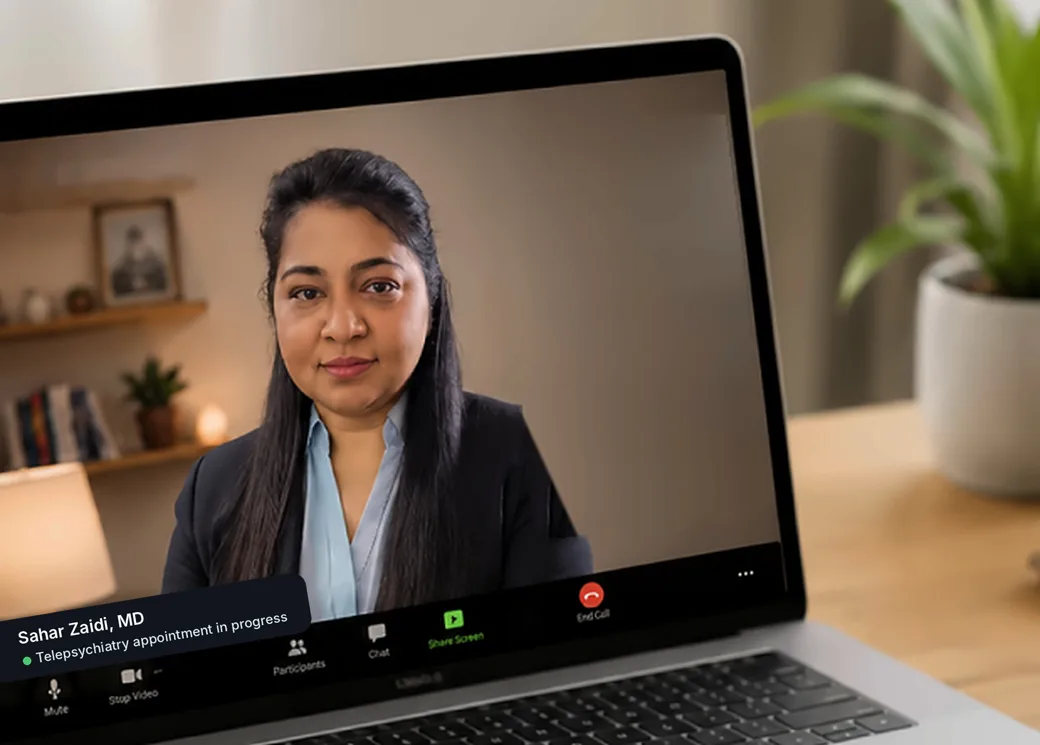
Secure, HIPAA-compliant video visits for children, teens and adults who are in Virginia or Maryland during the appointment.
Plans accepted
Integral Psychiatric Care accepts Cigna, Aetna, BCBS, Anthem, CareFirst, UHC, Optum, UMR and Anthem BCBS FEP (Federal Employee Program), plus some other plans.
Self-pay is available, and superbills may help with out-of-network reimbursement.
Medicare and Medicaid are not accepted.
Coverage varies by plan, including for video visits. Please confirm your benefits with your insurer.
Questions about coverage?
703-991-0564
Billing questions: 703-783-4620
FAQs
Grouped by who the question is about.
Integral Psychiatric Care sees children from age 5. For young children, guidelines recommend behavior-focused parent training and classroom supports as the first step, and the evaluation looks at how your child is doing at home and at school.
Many pediatricians diagnose and treat ADHD. Specialist psychiatric care can help when the picture is more complicated, for example when anxiety, mood, sleep or behavior concerns are also present, or when treatment so far hasn’t worked well. With your consent, we keep your pediatrician informed.
Medication isn’t meant to change who your child is; the goal is help with focus and self-control. If your child doesn’t seem like themselves, tell your provider. Follow-up visits are there to check exactly this, and the plan can be adjusted.
No. Medication is one option, considered only when the evaluation supports it. For young children, guidelines recommend parent training and classroom supports first. You decide together with your child’s provider.
Yes. Teens are part of the conversation from the first visit. Your provider talks with your teen and with you, and the plan is decided together, including any decision about medication.
That depends on how the plan is working and on your teen’s own views. Guidelines recommend medication for teens with their agreement, along with skills-based support. The plan is reviewed at follow-up visits and adjusted as your teen’s needs change.
ADHD starts in childhood, but many people aren’t diagnosed until adulthood, when demands at work or home make it harder to cope. The evaluation looks back at childhood, because several symptoms need to have been present before age 12. Old report cards help if you have them; they aren’t required.
You start the same way as every new patient: intake forms, then an initial psychiatric evaluation. Upload a list of your current medicines and any earlier evaluation reports to your patient portal before the visit. Your provider reviews your history and discusses the options with you.
Not necessarily. Sleep, stress, anxiety, low mood, learning differences and some health conditions can all affect focus. ADHD is a lasting pattern that started in childhood and shows up in more than one part of life. The evaluation finds the cause.
There’s no single test. ADHD is diagnosed through a careful psychiatric evaluation. Online quizzes can prompt good questions but can’t diagnose it. Formal psychological testing isn’t needed for most people; your provider explains if it would help.
ADHD tends to run in families, and genes are one of several contributing factors. Others include being born early or at a low birth weight, and some exposures before birth. Parenting style doesn’t cause ADHD.
Your provider explains what the evaluation found and what may be causing the difficulties, and discusses care for that, such as anxiety, mood or sleep, or other next steps.
Request an appointment
Request an evaluation for yourself or your child. Our intake team will reach out to talk through next steps and scheduling.
Prefer to call? Talk with our intake team at 703-991-0564.
Your information is kept confidential. The limits, such as safety concerns, are explained at the first visit.
Sending a request does not confirm an appointment. Our intake team will contact you by phone, or by email if you prefer.
Sent through a secure, HIPAA-compliant form. Your information is used only to respond to your request. See our Privacy Policy.
Learn more
Outside resources on ADHD: National Institute of Mental Health: ADHD · CDC: ADHD
Medical disclaimer. This page is for general education and is not a substitute for professional medical advice, diagnosis or treatment.
✳ In Their Words
Start your journey to lasting mental wellness with personalized, evidence based psychiatric care for all ages.

Join families and individuals who trust Integral Psychiatric Care for expert, compassionate psychiatric support.
K. L.
2 reviews
November 2026
“Dr. Zaidi immediately understood what my son, who is autistic, needed and knew how to help him. She has years of medical and specialty training, along with an extraordinary bedside manner. She is thorough, patient, and …”
G Posted on
Google
C. P.
5 reviews
May 2026
"Dr. Zaidi is a great Doctor. She always listens very carefully and provides insights and recommendations with honesty and professionalism. She makes sure to follow through with what is needed to improve the health of the patient and in a …"
G Posted on
Google
Hear from others
See what people share about their experiences with Integral Psychiatric Care.
Integral Psychiatric Care uses cookies to operate this site and, with your permission, analyze usage and measure advertising performance. Manage your choices in Cookie settings or learn more in our Privacy Policy.
Choose which optional cookies we may use. You can change this at any time from "Cookie settings" at the bottom of every page. Learn more in our Privacy Policy.