

OCD & Intrusive Thoughts

OCD and unwanted intrusive thoughts: evaluation and treatment

Medically reviewed by Sahar Zaidi, MD, double board-certified in adult and child & adolescent psychiatry · Reviewed November 16, 2026

OCD can look like a thought that won’t leave, however hard you push it away. It can also be a check that has to be done one more time, or rituals that take over the morning. Parents may notice repeated checking, or the same question asked again and again.

Integral Psychiatric Care evaluates and treats obsessive-compulsive disorder (OCD), including intrusive thoughts, in person in Reston, Virginia, and by video in Virginia and Maryland.

After you send a request, our intake team will reach out to talk through next steps and scheduling.

Evaluation first, then a plan decided with you. You don’t need a diagnosis or a referral to ask for an evaluation.

A woman concentrating as she lines up colored pencils in an exact row on a white table

Double board-certified: Adult and Child & Adolescent Psychiatry

Washingtonian Top Doctor, Psychiatry, 2024 and 2025

  • Accepting new patients, ages 5 to 65
  • In person in Reston, or by video in Virginia and Maryland
  • No referral required by Integral Psychiatric Care
Who we see
Ages 5 to 65
First step
Initial psychiatric evaluation
Visit options
In person in Reston
Payment
Insurance or self-pay

What OCD is

What is OCD, and when is it more than a habit?

Obsessive-compulsive disorder (OCD) involves obsessions, compulsions or both. Obsessions are recurring, unwanted thoughts, urges or images. Compulsions are repeated actions or mental acts a person feels driven to do in response.[1][2]

Many people have an upsetting thought now and then, or double-check a door. In OCD, these take up a lot of time, cause distress or get in the way of daily life.[2]

OCD isn’t the same as liking things neat. People with OCD don’t get pleasure from their rituals, though they may feel brief relief.[1]

OCD affects about 1 to 2% of people in the United States.[2] It usually starts between late childhood and young adulthood.[1]

When it's more than a habit

  • Time: the thoughts or rituals take up a lot of your day, for example more than an hour[2]
  • Distress: they frighten you, upset you or leave you feeling stuck[2]
  • Interference: work, school, relationships or daily routines start to suffer[2]

These are reasons to ask. Only an evaluation can make a diagnosis.

Reasons to ask for an evaluation

The thoughts keep coming back

Unwanted thoughts, urges or images return, even when you try to ignore them or push them away.[2]

Rituals take up your time

Cleaning, checking, counting or arranging takes time you need for other things.[1]

You avoid what sets it off

You stay away from places or situations that bring on the thoughts or the urge to do a ritual.[1]

Others are pulled in

You keep asking people for reassurance, or family members have started helping with rituals.[2][3]

Common themes

What are the 4 types of OCD?

There are no four official types of OCD. The number comes from research: a large 2008 review of OCD studies found that symptoms tend to fall into four groups. Here is what each group means.

Symmetry and order

A strong need for things to be even or exact, often with arranging, repeating or counting.[1][2]

Unwanted thoughts and checking

Unwanted thoughts on taboo subjects or about harm, often with checking, silent rituals or asking for reassurance.[1][2]

Contamination and cleaning

Fear of germs or contamination, often with repeated washing or cleaning.[1][2]

Saving things

Trouble getting rid of possessions. Researchers count this as one of the four groups, and hoarding disorder is now its own diagnosis.[2]

What people mean by "pure O"

“Pure O” is a phrase people use for OCD with no rituals anyone can see. It isn’t a diagnosis. Compulsions can be silent, such as praying or repeating words in your head.[1]

Themes overlap and change

These groups can overlap, and the same review found that the pattern differs somewhat in children. A person’s obsessions and compulsions can also change over time.[1]

Intrusive thoughts

Do intrusive thoughts mean something about you?

Intrusive thoughts are unwanted thoughts, images or urges that seem to arrive on their own. Many people without OCD have distressing thoughts at times.[2] Most people with OCD know or suspect their obsessional thoughts aren’t realistic, and the thoughts can still be very hard to dismiss.[2]

A passing thought, or something that may be OCD?
QuestionA passing unwanted thoughtWhen it may be OCD
How it behavesComes up, feels odd or unpleasant, and moves onRecurs and persists, even when you try to ignore it[2]
What you do about itNot muchRituals, checking, seeking reassurance or avoiding situations[1][2]
How much it gets in the wayLittle effect on your day[2]Takes up time, causes distress or disrupts daily life[2]

If you're afraid of acting on a thought

In OCD, a thought about harming someone is a fear, and it goes against what the person wants. A 2009 clinical review reported no recorded cases of a person with OCD carrying out this kind of obsession.[7]

The same review notes limits: the picture can differ when another condition is present, and it’s harder to judge in young children.[7] An evaluation can look at what the fear means for you.

If you have thoughts of suicide or self-harm, or you feel you might hurt someone, call or text 988 now, or call 911 in an emergency.

Saying the thoughts aloud

Some people don’t tell a provider about their obsessions and compulsions, out of fear of judgment.[1] Your provider needs to hear them to make the right diagnosis.

You’ll be treated with respect, and your information is kept confidential. The limits, such as safety concerns, are explained at the first visit.

Signs by age

Signs of OCD in children, teens and adults

OCD can begin in childhood, and it doesn’t look the same at every age. Children may not realize their behavior is out of the ordinary, so parents or teachers are often the ones who notice.[1] Choose an age group to see common signs.

Signs of OCD in children

  • Fear that something bad will happen to them or to their family[3]
  • Checking doors and windows again and again[3]
  • Repeated hand washing, checking or counting[3]
  • Asking the same question or for reassurance again and again[2]
  • Feeling ashamed, and hiding the symptoms[3]
  • Trouble at school, with friends or at home because of the symptoms[3]

Signs of OCD in teens

  • Fear of germs, illness or contaminated food[3]
  • Unwanted thoughts or images that cause intense anxiety[3]
  • Washing, checking or counting rituals[3]
  • Feeling ashamed, and hiding the symptoms[3]
  • Symptoms that interfere with school, friendships or family life[3]
  • Symptoms that get worse during times of stress[1]

Signs of OCD in adults

  • Repeated, unwanted thoughts, urges or mental images[1]
  • Excessive cleaning or handwashing[1]
  • Checking that the door is locked or the oven is off, over and over[1]
  • Arranging items in a particular, precise way[1]
  • Counting, or praying or repeating words silently[1]
  • Seeking reassurance from others again and again[2]
  • Spending more than an hour a day on thoughts or rituals[1]
  • Avoiding situations that set off the symptoms[1]

What families can do

Families often try to ease the distress by joining a ritual, answering the same question or changing plans around it. This is called accommodation, and it often happens without anyone realizing how much.[3]

Studies link it with more severe symptoms, and experts advise against it.[2] Your provider talks through how to respond during visits.

As many as 1 in 200children and teens may have OCD.[3] Recognizing these signs is a reason to ask, not a diagnosis.

How it’s diagnosed

How is OCD diagnosed?

OCD is diagnosed through a psychiatric evaluation, a conversation about your thoughts, rituals, history and daily life. No single test can show it, and medical tests are sometimes used to check for physical conditions.

  1. Request and intake

    Send a request or call 703-991-0564. Our intake team talks through what’s going on, your insurance and scheduling.

  2. Your initial psychiatric evaluation

    In person in Reston or by secure video. Your provider asks what the thoughts and rituals are, how much time they take and how they affect daily life. You’ll also talk about health, medicines and other conditions.

    A parent or guardian joins every visit for ages 5 to 17, and adults are welcome to bring a family member or partner.

  3. Looking at what else could explain it

    Your provider considers conditions that can look like OCD or occur with it. Some medical causes may need a check with your primary care provider.

  4. Findings and a first plan

    Toward the end of the visit, your provider explains the findings in plain language and shares a preliminary plan, decided together. If it isn’t OCD, your provider explains what the evaluation found and discusses care for that, or other next steps.

You don't need proof to start

You don’t need to be sure it’s OCD; finding out is what the evaluation is for. Integral Psychiatric Care doesn’t require a referral, though some insurance plans do. You can upload earlier records and a list of your medicines to your patient portal before the visit.

What can look like OCD, or come with it
It may beHow it can differ
Obsessive-compulsive personality disorder (OCPD)A lasting personality pattern of order, perfectionism and control, without true obsessions. People are usually comfortable with the behavior, while people with OCD are often distressed by it. The two can occur together.[6]
AnxietyWorry about everyday concerns, usually without rituals to undo it. Anxiety often occurs with OCD.
DepressionLow mood is the center, and it often comes with OCD.
TicsRepetitive movements or sounds. Some people with OCD also have a tic disorder.
Autism-related routinesRepetitive behavior occurs in both, and they often occur together. Telling them apart can be hard, which is why the evaluation looks at the whole picture.
ADHDTrouble with attention and impulsivity. The two can occur together.

Treatment

How is OCD treated?

OCD is treated with therapy, medication or both.[1] Which fits depends on how severe the OCD is, your age, what has been tried and your preferences. The plan is decided together after the evaluation, and the reason for any medicine is explained.

Where treatment usually starts
SituationWhere treatment usually starts
Mild to moderate OCD in adultsTherapy, medication or both.[2][4]
Severe OCD in adultsTherapy and medication together.[2][4]
Children and teensTherapy that involves the family is the usual starting point.[4] Medication is decided individually, with the parent or guardian.

Antidepressants carry an FDA boxed warning about suicidal thoughts and behavior in children, teens and young adults under 25, so anyone starting one is watched closely. Antidepressants and young people ›

Exposure and response prevention (ERP)

ERP is a type of CBT and a first-line therapy for OCD.[2] You spend time with what sets off the obsession, in planned steps, without doing the ritual.[1]

ERP is a structured course of therapy with a therapist trained in it. If you already work with one, you can keep them, and with your consent, care is coordinated. If you don’t, your provider can talk with you about options.


Therapy and skills

CBT skills, DBT skills, and individual, family and supportive therapy are offered here. They can help with coping, stress and mood alongside OCD treatment. You can keep a therapist you already see; with your consent, care is coordinated.

Medication, when it fits

The medicines most often used for OCD are antidepressants that act on serotonin, called SSRIs.[1][2] They can take up to about 12 weeks to help, so stopping early can make them seem not to work.[1][2][4] Please talk with your provider before stopping any medicine.[1]

At the evaluation, your provider reviews each medicine you take now and may continue it, adjust the dose, or stop it and prescribe a different one.

For children and teens

A parent or guardian is with us at every visit for patients 5 to 17. Not all children with OCD need medication.[3] If medicine may help, the risks and benefits are explained first and the decision is made with you.

The first follow-up is usually about 2 to 3 weeks after the evaluation. As symptoms improve and things are stable, visits are usually spaced to every 1 to 2 months.

If treatment isn't helping

Tell your provider, because therapy and medication can both take some time to work.[1] Your provider first checks practical things, such as whether medicine is taken as prescribed, and whether the diagnosis still fits. Then the plan changes, decided together.

When more support is needed

Some people need more support than outpatient visits can give. When that happens, Integral Psychiatric Care refers them to a more intensive program, such as intensive outpatient or partial hospitalization.

Sahar Zaidi, MD, founder of Integral Psychiatric Care

Meet Dr. Zaidi

Sahar Zaidi, MD

Founder and Medical Director

Dr. Zaidi evaluates and treats children, teens and adults. Because she treats all three, she sees how OCD can change from one stage of life to the next.

  • Board-certified in Adult Psychiatry and Child & Adolescent Psychiatry
  • Diplomate, American Board of Psychiatry and Neurology
  • Child & Adolescent Psychiatry fellowship, University of Michigan, Ann Arbor
  • Washingtonian Top Doctor, Psychiatry, 2024 and 2025

What you can expect here

  • One practice for ages 5 to 65; a parent and a child can both be patients here
  • Evaluation, medication management and therapy in the same practice
  • A parent or guardian joins every visit for ages 5 to 17, and teens also get time on their own
  • With your consent, coordination with a school or other clinicians

Visit options

In-person care in Reston, video visits in Virginia and Maryland

Choose an in-person visit at the Reston office or a secure video visit. Our intake team can walk you through visit options and insurance before your first appointment.

A consultation room at the Reston office with a sofa, armchairs and a window

Reston office

1768 Business Center Drive, Suite 360, Reston, VA 20190

Mon–Fri, 8:30 a.m.–5:30 p.m., by appointment only. No walk-in appointments. Closed Saturday, Sunday and all major holidays.

Patients come from across Northern Virginia, including Herndon, Fairfax and Ashburn, and from Maryland communities such as Bethesda and Rockville. D.C. residents are welcome to be seen in person here.

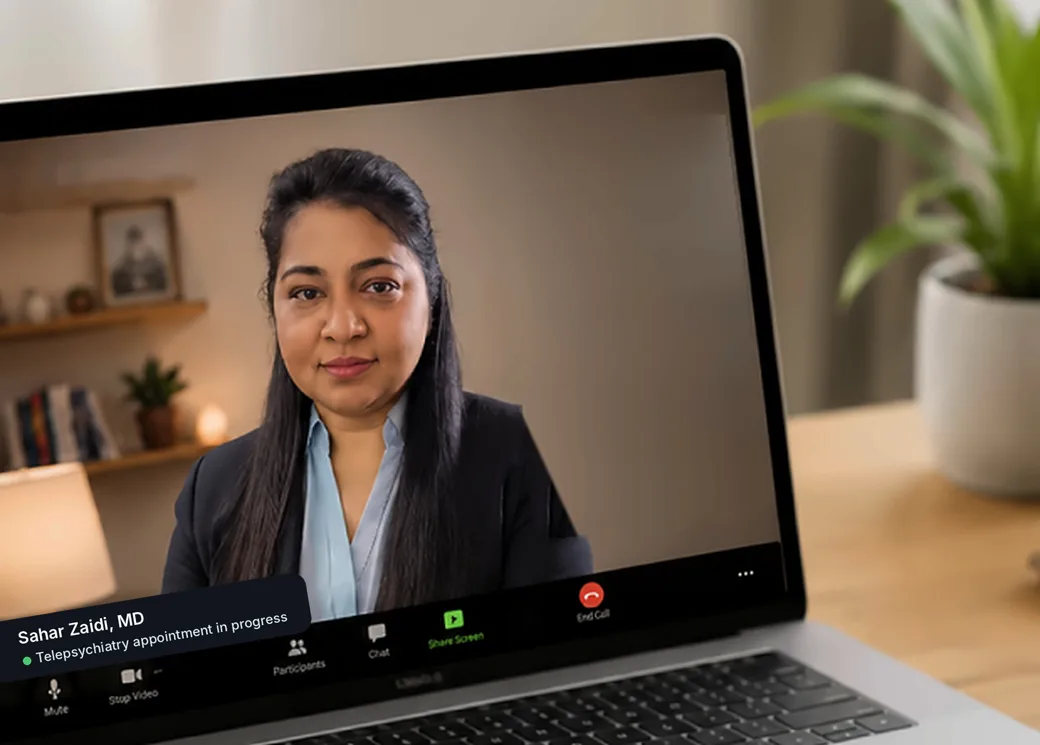
Sahar Zaidi, MD, on a laptop screen during a video visit

Video visits

Secure, HIPAA-compliant video visits for children, teens and adults who are in Virginia or Maryland during the appointment.

  • Your first evaluation can be by video.
  • A parent or guardian joins children’s video visits.
  • Join from a private place, not while driving.
  • Video visits aren’t available while you’re in D.C.

Plans accepted

  • Cigna
  • Aetna
  • BCBS
  • Anthem
  • CareFirst
  • UHC
  • Optum
  • UMR
  • Anthem BCBS FEP

Insurance and payment

Integral Psychiatric Care accepts Cigna, Aetna, BCBS, Anthem, CareFirst, UHC, Optum, UMR and Anthem BCBS FEP (Federal Employee Program), plus some other plans.

Self-pay is available, and superbills may help with out-of-network reimbursement.

Medicare and Medicaid are not accepted.

Coverage varies by plan, including for video visits. Please confirm your benefits with your insurer.

FAQs

Questions about OCD care

Grouped by who, or what, the question is about.

Prefer to speak with our intake team?

My child or teen

Can children have OCD, and at what age can my child be seen?

Yes, OCD can begin in childhood.[1] Integral Psychiatric Care sees children from age 5, and a parent or guardian joins every visit for ages 5 to 17. You and your child or teen each get some time with the provider on your own.

My child keeps asking for reassurance. Should I keep answering?

Seeking reassurance again and again can be a compulsion in OCD, and answering each time can become a form of accommodation.[2][3] Studies link accommodation with more severe symptoms, which doesn’t mean a parent caused the OCD. Your provider talks through how to respond during visits, so you know what to do the next time your child asks.

My child’s symptoms came on suddenly. What should I do?

Start by talking to your child’s primary care provider, and say how quickly the symptoms came on.[5] A sudden, severe start of OCD symptoms in a child can be part of conditions called PANS and PANDAS. No lab test can confirm them.[5]

Intrusive thoughts

Does having intrusive thoughts mean I have OCD?

Not by itself. Many people without OCD have distressing thoughts, but these aren’t time consuming or impairing.[2] OCD is more likely when the thoughts keep returning, come with rituals, and take up time or disrupt daily life.

I’m afraid I might act on my thoughts. What does that mean?

If you have thoughts of suicide or self-harm, or you feel you might hurt someone, call or text 988 now, or call 911 in an emergency.

Fear of causing harm is a known OCD theme. A 2009 clinical review reported no recorded cases of a person with OCD carrying out this kind of obsession.[7] It notes limits when another condition is present and in young children, so please bring this fear to your provider.

Do I have to tell my provider what the thoughts are?

It helps your provider make the right diagnosis. Some people hold back out of fear of judgment.[1]

You’ll be treated with respect, and your information is kept confidential. The limits, such as safety concerns, are explained at the first visit.

Treatment

Does OCD go away? Can it be cured?

There is no cure for OCD, and treatment helps many people, even those with the most severe forms.[1] Symptoms can go away for a while or get worse, often during times of stress.[1] Your provider checks progress at follow-up visits.

What causes OCD?

The exact causes are unknown.[1] OCD tends to run in families, though a child can develop it with no family history.[3] Studies also point to differences in the brain, and some have found an association with childhood trauma.[1]

Is there medication for OCD, and how long does it take?

Yes, the medicines most often used are antidepressants that act on serotonin, called SSRIs.[1][2] They can take up to about 12 weeks to help.[1][2][4] If medicine helps, UK guidelines for adults suggest continuing for at least 12 months to prevent relapse, and your provider decides this with you.[4]

Do I need a psychiatrist or a therapist for OCD, and can I keep my therapist?

A psychiatrist is a medical doctor who can diagnose OCD, look for other conditions, and prescribe and monitor medicine. ERP is a structured course of therapy with a therapist trained in it.

If you already work with one, you can keep them, and with your consent, care is coordinated. If you don’t, your provider can talk with you about options. You don’t have to work this out before the first visit.
Everyone

Is OCD an anxiety disorder?

Doctors now place OCD in its own group, obsessive-compulsive and related disorders, apart from anxiety disorders.[2] Anxiety is still often part of OCD: obsessions can cause it, and it often occurs alongside OCD.

Is OCD the same as OCPD?

No, obsessive-compulsive personality disorder (OCPD) is a lasting pattern of order, perfectionism and control, without true obsessions.[6] People with OCPD are usually comfortable with the behavior, while people with OCD are often distressed by it.[6] A person can have both.

Can OCD be treated by video?

Yes. Evaluations and follow-up visits, including medication management, can be by video while you are physically in Virginia or Maryland. Video visits are limited to Virginia and Maryland because Sahar Zaidi, MD is licensed to practice medicine in those two states.

D.C. residents can be seen in person in Reston. Join from a private place, not while driving. Telepsychiatry: video visits in Virginia and Maryland ›

Request an appointment

Talk with us about OCD

Request an evaluation for yourself, your teen or your child. Our intake team will reach out to talk through next steps and scheduling.

Prefer to call? Talk with our intake team at 703-991-0564.

Your information is kept confidential. The limits, such as safety concerns, are explained at the first visit.

  • Appointments703-991-0564
  • Billing703-783-4620
  • Fax866-526-7323
  • Emailadmin@integralpsychiatriccare.com
  • Office1768 Business Center Drive, Suite 360, Reston, VA 20190
  • HoursMon–Fri, 8:30 a.m.–5:30 p.m., by appointment only. No walk-in appointments. Closed Saturday, Sunday and all major holidays.

All fields are required. Requesting care for your child or someone else? Enter your own details and mention who the appointment is for.

This form is not for emergencies. If you or someone else is in crisis, call or text 988, or call 911.

Sending a request does not confirm an appointment. Our intake team will contact you by phone, or by email if you prefer.

Sent through a secure, HIPAA-compliant form. Your information is used only to respond to your request. See our Privacy Policy.

Learn more

Medical disclaimer. This page is for general education and is not a substitute for professional medical advice, diagnosis or treatment.

References 7 sources

  1. National Institute of Mental Health. Obsessive-Compulsive Disorder: When Unwanted Thoughts or Repetitive Behaviors Take Over. NIH Publication No. 23-MH-4676, revised 2023. nimh.nih.gov
  2. American Psychiatric Association. What Are Obsessive-Compulsive and Related Disorders? Physician review September 2024. psychiatry.org
  3. American Academy of Child and Adolescent Psychiatry. Obsessive-Compulsive Disorder in Children and Adolescents. Facts for Families No. 60, updated October 2023. aacap.org
  4. National Institute for Health and Care Excellence. Obsessive-compulsive disorder and body dysmorphic disorder: treatment. Clinical guideline CG31. nice.org.uk
  5. National Institute of Mental Health. PANS and PANDAS: Questions and Answers. Revised 2025. nimh.nih.gov
  6. Zimmerman M. Obsessive-Compulsive Personality Disorder. MSD Manual Consumer Version, full review September 2023, last updated January 2026. msdmanuals.com
  7. Veale D, et al. Risk assessment and management in obsessive-compulsive disorder. Advances in Psychiatric Treatment. 2009;15:332-343. cambridge.org

✳   In Their Words

Experiences From the People
We Care For

Start your journey to lasting mental wellness with personalized, evidence based psychiatric care for all ages.

Join families and individuals who trust Integral Psychiatric Care for expert, compassionate psychiatric support.

K. L.
2 reviews

November 2026

“Dr. Zaidi immediately understood what my son, who is autistic, needed and knew how to help him. She has years of medical and specialty training, along with an extraordinary bedside manner. She is thorough, patient, and …”

G   Posted on
        Google

C. P.
5 reviews

May 2026

"Dr. Zaidi is a great Doctor. She always listens very carefully and provides insights and recommendations with honesty and professionalism. She makes sure to follow through with what is needed to improve the health of the patient and in a …"

G   Posted on
        Google