


Trauma & PTSD

Trauma and PTSD: psychiatric evaluation and treatment in Reston, VA

Medically reviewed by Sahar Zaidi, MD, double board-certified in adult and child & adolescent psychiatry · Reviewed November 16, 2026

After something frightening, it’s common to sleep badly, feel on edge or replay what happened. For most people this eases with time. When it doesn’t, or when it starts to shape your days, it may be PTSD.

Integral Psychiatric Care evaluates and treats PTSD and other trauma-related problems, in person in Reston, Virginia, and by video in Virginia and Maryland.

After you send a request, our intake team will reach out to talk through next steps and scheduling.

Evaluation first, then a plan decided with you. You don’t need a diagnosis or a referral to ask for an evaluation.

A clinician taking notes while she rests a reassuring hand on the hands of a woman sitting beside her

Double board-certified: Adult and Child & Adolescent Psychiatry

Washingtonian Top Doctor, Psychiatry, 2024 and 2025

  • Accepting new patients, ages 5 to 65
  • In person in Reston, or by video in Virginia and Maryland
  • No referral required by Integral Psychiatric Care
Who we see
Ages 5 to 65
First step
Initial psychiatric evaluation
Visit options
In person in Reston
Payment
Insurance or self-pay

What PTSD is

What is PTSD, and when do trauma reactions become PTSD?

Posttraumatic stress disorder (PTSD) can follow a frightening event that you lived through or witnessed. Most people recover from their symptoms over time. When symptoms last more than a month and get in the way of daily life, it may be PTSD.[1][2]

Strong reactions in the first month are called acute stress disorder when they are severe. About half of people with it go on to develop PTSD.[2] PTSD can also start months or even years after the event.[5]

Anyone can develop PTSD at any age, and women are more likely to than men.[1] About 4% of U.S. adults have PTSD in a given year.[2]

Signs it may be more than a normal reaction

  • Symptoms that last longer than a month after the event[1][2]
  • Flashbacks, nightmares or memories that keep coming back[1]
  • Avoiding places, people or thoughts that bring it back[1]
  • Work, school, sleep or relationships suffering[2]

These are reasons to ask. Only an evaluation can make a diagnosis.

The four groups of PTSD symptoms

Reliving the event

Flashbacks, with physical signs such as a racing heart or sweating, plus recurring memories, dreams or distressing thoughts.[1]

Avoidance

Staying away from reminders, such as no longer driving after a serious car accident.[1]

Changes in thinking and mood

Negative thoughts about yourself or the world, or ongoing fear, guilt or shame.[1]

Feeling on edge

Being easily startled, feeling tense, or having trouble sleeping.[1]

What is complex PTSD?

Some trauma is long-lasting, happens in childhood or involves harm by another person. People often use the term complex PTSD for what can follow.[4]

The World Health Organization’s ICD-11 lists complex PTSD as its own diagnosis. It adds problems managing emotions, feeling worthless and difficulty feeling close to others. The U.S. diagnostic manual (DSM-5) has no separate diagnosis and includes these symptoms within PTSD.[4]

The same treatments work well for PTSD and complex PTSD, and trauma-focused treatment is a good place to start.[4]

If you’re having thoughts of suicide or of harming yourself, call or text 988 now, or call 911 if you’re in immediate danger.

About the "17 symptoms of PTSD"

Lists online often count 17 symptoms, from an older edition of the diagnostic manual. The current DSM-5 lists 20 symptoms in the four groups above.[3]

The same edition moved PTSD out of the anxiety disorders, into a group called trauma- and stressor-related disorders.[3]

Signs by age

Signs of PTSD in children, teens and adults

Trauma doesn’t show up the same way at every age. Young children often show it through play and behavior, while teens’ symptoms look more like adults’.[1] Choose an age group to see common signs.

Signs of PTSD in children

  • Acting out the event again and again in play[1][6]
  • Upsetting, frightening dreams[6]
  • Being unusually clingy with a parent or other adult[1]
  • Acting younger than their age, or wetting the bed after being toilet trained[1][6]
  • Avoiding places or situations that remind them of what happened[6]
  • Being more alert or watchful than usual[6]

Signs of PTSD in teens

  • Flashbacks or memories of the event that keep coming back[1]
  • Avoiding reminders, people or places linked to it[1]
  • Being easily startled, tense or irritable[1]
  • Trouble sleeping[1]
  • Guilt, shame or negative thoughts about themselves[1]
  • Disruptive, disrespectful or destructive behavior[1]

Signs of PTSD in adults

  • Flashbacks, with a racing heart or sweating[1]
  • Recurring memories or dreams about the event[1]
  • Avoiding places, events or objects that are reminders[1]
  • Being easily startled, or feeling tense and on edge[1]
  • Trouble sleeping, or angry outbursts[1]
  • Ongoing fear, guilt or shame, or losing interest in things you enjoyed[1]

What families can do

Support from parents, school and friends matters, and helping a child feel safe again comes first.[6] For an adult, patience and support help, along with encouragement to get an accurate diagnosis.[1]

If symptoms haven’t eased after 6 to 8 weeks, encourage them to talk with a health care provider.[1]

About 8%of U.S. teens ages 13 to 18 have PTSD.[2] Recognizing these signs is a reason to ask, not a diagnosis.

How it’s diagnosed

How is PTSD diagnosed?

A mental health professional diagnoses PTSD by looking at whether your symptoms meet the criteria.[1] Symptoms from all four groups need to last more than a month and cause real distress or trouble in daily life.[1][2]

  1. Request and intake

    Send a request or call 703-991-0564. Our intake team talks through what’s going on, your insurance and scheduling.

  2. Your initial psychiatric evaluation

    In person in Reston or by secure video. Your provider asks about symptoms, sleep, mood, health, medicines, alcohol and other substances, and how daily life is affected. If talking about what happened is hard, say so.

    A parent or guardian joins every visit for ages 5 to 17, and adults are welcome to bring a family member or partner.

  3. Looking at what else could explain it

    Your provider considers conditions that look like PTSD or often come with it, such as depression, anxiety and substance use.[5]

  4. Findings and a first plan

    Toward the end of the visit, your provider explains the findings in plain language and shares a preliminary plan, decided together. If it isn’t PTSD, your provider explains what the evaluation found and discusses next steps.

You don't need proof to start

You don’t need to be sure it’s PTSD; finding out is what the evaluation is for. Integral Psychiatric Care doesn’t require a referral, though some insurance plans do. You can upload earlier records and a list of your medicines to your patient portal before the visit.

What can look like PTSD, or come with it
It may beHow it can differ
Acute stress disorderSimilar symptoms from 3 days to 1 month after the event. About half of people with it develop PTSD.[2]
Stress after a hard life changeFollows a stressful change, such as a job loss, rather than a frightening event. It’s covered on the anxiety and stress page.
DepressionLow mood and loss of interest lead. It often occurs with PTSD.[5]
AnxietyWorry that isn’t tied to a past event. Anxiety disorders often occur with PTSD.[5]
Substance useAlcohol or drugs can be used to cope. Substance use problems are common in people with PTSD.[5]
Sleep problemsPoor sleep and nightmares are part of PTSD, and they can also have other causes.[1]

Treatment

How is PTSD treated?

PTSD is treated with talk therapy, medication or both, and both are effective.[2] Trauma-focused therapy has the strongest evidence for most people.[5] The plan is decided with you after the evaluation, and the reason for any medicine is explained.

Trauma-focused therapy

These therapies help you work through the memory and its meaning, in planned steps. Examples are cognitive behavioral therapy with exposure and cognitive restructuring, and EMDR.[1][2] A course usually lasts 6 to 12 weeks or longer.[1]

Trauma-focused therapy is a structured course of therapy with a therapist trained in it. If you already work with one, you can keep them, and with your consent, care is coordinated. If you don’t, your provider can talk with you about options.


Medication, when it fits

Antidepressants called SSRIs and SNRIs are commonly used.[2] Other medicines may help with sleep problems or nightmares.[1] Medicine is often used for symptoms such as depression or anxiety, alongside therapy.[5]

At the evaluation, your provider reviews each medicine you take now and may continue it, adjust the dose, or stop it and prescribe a different one.

Therapy and skills

CBT skills, DBT skills, and individual, family and supportive therapy are offered here. They can help with coping, sleep routines, stress and mood. You can keep a therapist you already see; with your consent, care is coordinated.

For children and teens

Trauma-focused CBT is an evidence-based treatment for children and teens.[2] Helping the child feel safe comes first.[6] A parent or guardian is with us at every visit for patients 5 to 17.

Antidepressants carry an FDA boxed warning about suicidal thoughts and behavior in children, teens and young adults under 25, so anyone starting one is watched closely. Antidepressants and young people ›

The first follow-up is usually about 2 to 3 weeks after the evaluation. As symptoms improve and things are stable, visits are usually spaced to every 1 to 2 months.

If treatment isn't helping

Tell your provider. Your provider first checks practical things, such as sleep, alcohol, new stress and whether medicine is taken as prescribed. Whether the diagnosis still fits is checked too. Then the plan changes, decided together.

When more support is needed

Some people need more support than outpatient visits can give. When that happens, Integral Psychiatric Care refers them to a more intensive program, such as intensive outpatient or partial hospitalization.

Sahar Zaidi, MD, founder of Integral Psychiatric Care

Meet Dr. Zaidi

Sahar Zaidi, MD

Founder and Medical Director

Dr. Zaidi evaluates and treats children, teens and adults. Because she treats all three, she sees how trauma can show up differently from one stage of life to the next.

  • Board-certified in Adult Psychiatry and Child & Adolescent Psychiatry
  • Diplomate, American Board of Psychiatry and Neurology
  • Child & Adolescent Psychiatry fellowship, University of Michigan, Ann Arbor
  • Washingtonian Top Doctor, Psychiatry, 2024 and 2025

What you can expect here

  • One practice for ages 5 to 65; a parent and a child can both be patients here
  • Evaluation, medication management and therapy in the same practice
  • A parent or guardian joins every visit for ages 5 to 17, and teens also get time on their own
  • With your consent, coordination with a school or other clinicians

Visit options

In-person care in Reston, video visits in Virginia and Maryland

Choose an in-person visit at the Reston office or a secure video visit. Our intake team can walk you through visit options and insurance before your first appointment.

A consultation room at the Reston office with a sofa, armchairs and a window

Reston office

1768 Business Center Drive, Suite 360, Reston, VA 20190

Mon–Fri, 8:30 a.m.–5:30 p.m., by appointment only. No walk-in appointments. Closed Saturday, Sunday and all major holidays.

Patients come from across Northern Virginia, including Herndon, Fairfax and Ashburn, and from Maryland communities such as Bethesda and Rockville. D.C. residents are welcome to be seen in person here.

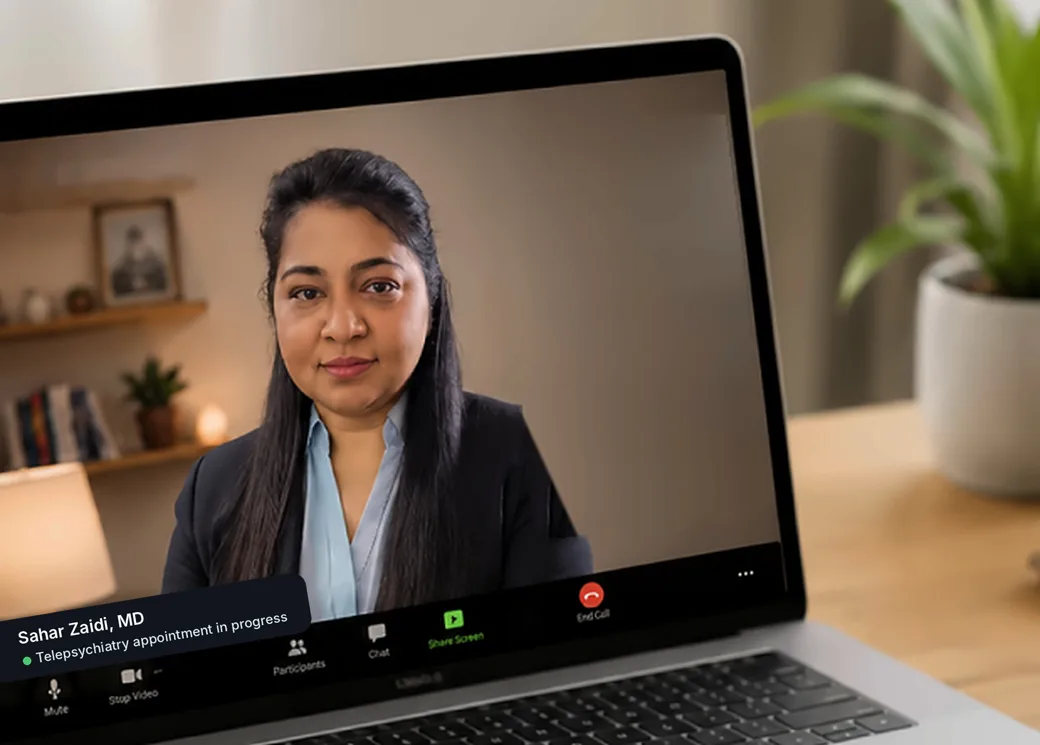
Sahar Zaidi, MD, on a laptop screen during a video visit

Video visits

Secure, HIPAA-compliant video visits for children, teens and adults who are in Virginia or Maryland during the appointment.

  • Your first evaluation can be by video.
  • A parent or guardian joins children’s video visits.
  • Join from a private place, not while driving.
  • Video visits aren’t available while you’re in D.C.

Plans accepted

  • Cigna
  • Aetna
  • BCBS
  • Anthem
  • CareFirst
  • UHC
  • Optum
  • UMR
  • Anthem BCBS FEP

Insurance and payment

Integral Psychiatric Care accepts Cigna, Aetna, BCBS, Anthem, CareFirst, UHC, Optum, UMR and Anthem BCBS FEP (Federal Employee Program), plus some other plans.

Self-pay is available, and superbills may help with out-of-network reimbursement.

Medicare and Medicaid are not accepted.

Coverage varies by plan, including for video visits. Please confirm your benefits with your insurer.

FAQs

Questions about trauma and PTSD care

Grouped by who, or what, the question is about.

Prefer to speak with our intake team?

My child or teen

Can children get PTSD?

Yes. Anyone can develop PTSD at any age.[1] Young children may show it through play, clinginess or acting younger than their age.[1][6]

Integral Psychiatric Care sees children from age 5, and a parent or guardian joins every visit for ages 5 to 17.

My child went through something frightening. Should we wait and see?

Many children and adults recover over time.[1] Getting help early matters, though, especially if the trauma was serious or repeated.[6] If symptoms haven’t eased after 6 to 8 weeks, or they’re getting in the way of school or home life, ask for an evaluation.[1]

How can parents help?

Help your child feel safe, and keep support from family, school and friends close.[6] Children often do better when they can talk, draw, play or write about what happened, in their own time.[6] Your provider can talk with you about what to say and do at home.

Symptoms

Is PTSD an anxiety disorder?

Not anymore. The current diagnostic manual (DSM-5) moved PTSD out of the anxiety disorders, into trauma- and stressor-related disorders.[3] Anxiety is still common with PTSD, and the two often occur together.[5]

What are the 17 symptoms of PTSD?

The figure 17 comes from an older edition of the diagnostic manual. The current DSM-5 lists 20 symptoms in four groups: reliving the event, avoidance, changes in thinking and mood, and feeling on edge.[3] An evaluation looks at which apply to you.

Can PTSD start years after the event?

Yes. PTSD can develop months or even years after a trauma.[5] If new symptoms appear long after something frightening, it’s still worth asking about.

What if I’m having thoughts of suicide?

If you’re having thoughts of suicide or of harming yourself, call or text 988 now, or call 911 if you’re in immediate danger.

Integral Psychiatric Care is an outpatient practice and doesn’t provide emergency or crisis care.

Treatment

Does PTSD go away?

Most people recover from trauma symptoms over time, while some have symptoms that last a year or longer.[1] Talk therapy and medication are both effective treatments for PTSD.[2] Your provider checks progress at follow-up visits.

Can PTSD be treated with medication?

Yes. Antidepressants called SSRIs and SNRIs are commonly used, and other medicines may help with sleep or nightmares.[1][2] For most people, trauma-focused therapy has stronger evidence, and the two can be used together.[1][5]

Do I need a psychiatrist or a trauma therapist, and can I keep my therapist?

A psychiatrist is a medical doctor who can diagnose PTSD, look for other conditions, and prescribe and monitor medicine. Trauma-focused therapy is a structured course of therapy with a therapist trained in it.

If you already work with one, you can keep them, and with your consent, care is coordinated. If you don’t, your provider can talk with you about options.
Everyone

How can I help someone with PTSD?

Help them get an accurate diagnosis and treatment, and offer patience and support.[1] Listen without pushing them to talk. If symptoms haven’t improved after 6 to 8 weeks, encourage them to talk with their health care provider.[1]

Can PTSD be treated by video?

Yes. Evaluations and follow-up visits, including medication management, can be by video while you are physically in Virginia or Maryland. Video visits are limited to Virginia and Maryland because Sahar Zaidi, MD is licensed to practice medicine in those two states.

D.C. residents can be seen in person in Reston. Join from a private place, not while driving. Telepsychiatry: video visits in Virginia and Maryland ›

Request an appointment

Talk with us about trauma and PTSD

Request an evaluation for yourself, your teen or your child. Our intake team will reach out to talk through next steps and scheduling.

Prefer to call? Talk with our intake team at 703-991-0564.

Your information is kept confidential. The limits, such as safety concerns, are explained at the first visit.

  • Appointments703-991-0564
  • Billing703-783-4620
  • Fax866-526-7323
  • Emailadmin@integralpsychiatriccare.com
  • Office1768 Business Center Drive, Suite 360, Reston, VA 20190
  • HoursMon–Fri, 8:30 a.m.–5:30 p.m., by appointment only. No walk-in appointments. Closed Saturday, Sunday and all major holidays.

All fields are required. Requesting care for your child or someone else? Enter your own details and mention who the appointment is for.

This form is not for emergencies. If you or someone else is in crisis, call or text 988, or call 911.

Sending a request does not confirm an appointment. Our intake team will contact you by phone, or by email if you prefer.

Sent through a secure, HIPAA-compliant form. Your information is used only to respond to your request. See our Privacy Policy.

Learn more

Medical disclaimer. This page is for general education and is not a substitute for professional medical advice, diagnosis or treatment.

References 6 sources

  1. National Institute of Mental Health. Post-Traumatic Stress Disorder. NIH Publication No. 23-MH-8124, revised 2023. nimh.nih.gov
  2. American Psychiatric Association. What Is Posttraumatic Stress Disorder (PTSD)? Physician review March 2025. psychiatry.org
  3. U.S. Department of Veterans Affairs, National Center for PTSD. PTSD and DSM-5. Updated September 2026. ptsd.va.gov
  4. U.S. Department of Veterans Affairs, National Center for PTSD. Complex PTSD. Updated October 2026. ptsd.va.gov
  5. Barnhill JW. Posttraumatic Stress Disorder (PTSD). MSD Manual Professional Version, full review April 2026. msdmanuals.com
  6. American Academy of Child and Adolescent Psychiatry. Posttraumatic Stress Disorder (PTSD). Facts for Families No. 70, updated September 2023. aacap.org

✳   In Their Words

Experiences From the People
We Care For

Start your journey to lasting mental wellness with personalized, evidence based psychiatric care for all ages.

Join families and individuals who trust Integral Psychiatric Care for expert, compassionate psychiatric support.

K. L.
2 reviews

November 2026

“Dr. Zaidi immediately understood what my son, who is autistic, needed and knew how to help him. She has years of medical and specialty training, along with an extraordinary bedside manner. She is thorough, patient, and …”

G   Posted on
        Google

C. P.
5 reviews

May 2026

"Dr. Zaidi is a great Doctor. She always listens very carefully and provides insights and recommendations with honesty and professionalism. She makes sure to follow through with what is needed to improve the health of the patient and in a …"

G   Posted on
        Google