
Bipolar Disorder

Bipolar disorder assessment and treatment, including bipolar depression

Medically reviewed by Sahar Zaidi, MD, double board-certified in adult and child & adolescent psychiatry · Reviewed October 24, 2026

Bipolar disorder can bring stretches of unusual energy and little need for sleep, then weeks of depression that are hard to lift. Some people only notice the lows. Others feel so good during a high that nothing seems wrong.

Integral Psychiatric Care evaluates and treats bipolar disorder, including bipolar depression, in person in Reston, Virginia, and by video in Virginia and Maryland.

After you send a request, our intake team will reach out to talk through next steps and scheduling.

Evaluation first, then a plan decided with you. You don’t need a diagnosis or a referral to ask for an evaluation.

A woman sitting on a sofa, listening closely as she talks with a clinician who holds a clipboard

Double board-certified: Adult and Child & Adolescent Psychiatry

Washingtonian Top Doctor, Psychiatry, 2024 and 2025

  • Accepting new patients, ages 5 to 65
  • In person in Reston, or by video in Virginia and Maryland
  • No referral required by Integral Psychiatric Care
Who we see
Ages 5 to 65
First step
Initial psychiatric evaluation
Visit options
In person in Reston
Payment
Insurance or self-pay

What bipolar disorder is

What is bipolar disorder, and how is it different from mood swings?

Bipolar disorder brings periods of intense, unusual mood and energy, called mood episodes.[2] During an episode, symptoms last most of the day, every day, for a week or two or longer.[1]

That is what sets it apart from everyday ups and downs. A diagnosis needs at least one episode of mania or hypomania.[2]

Bipolar disorder affects about 2% of people in the United States to some degree.[4] It usually begins in the teens, 20s or 30s, and the average age of onset is in the mid-20s.[2][4] It can last a lifetime, and long-term treatment helps manage it.[1]

Signs it may be more than mood swings

  • Days of unusual energy or irritability with much less need for sleep[1]
  • Racing thoughts, fast talk, or feeling unusually important or powerful[1]
  • Weeks of low mood, slowed thinking or loss of interest at other times[1]
  • Work, school or relationships suffering during these periods[1]

These are reasons to ask. Only an evaluation can make a diagnosis.

Types of bipolar disorder

Bipolar I disorder

At least one manic episode, lasting at least a week. Depressive episodes are common too.[1][2]

Bipolar II disorder

At least one hypomanic episode and at least one major depressive episode, with no full mania.[2]

Cyclothymic disorder

For at least two years, many periods of milder high and low symptoms that don’t reach a full episode.[2]

Mixed features

Some episodes bring manic and depressive symptoms at the same time.[1] They can be harder to recognize.

Mania and hypomania

What do mania and hypomania look like?

Mania is a period of at least a week when a person is extremely high-spirited or irritable most of the day, nearly every day. Hypomania has milder symptoms and needs to last only four days in a row.[2]

During a manic or hypomanic episode, a person may

  • Feel very up, high or elated, or extremely irritable or touchy[1]
  • Need much less sleep without feeling tired[1]
  • Have racing thoughts, or talk fast about many different things[1]
  • Feel unusually important, talented or powerful[1]
  • Take on many things at once, or seek out risky pleasures such as spending or drinking[1]
  • Have trouble keeping up with work, social plans or relationships[1]

Hypomania can feel good and productive, so the person may not feel anything is wrong.[1] Family members often notice first, which is why their input helps at the evaluation.[4]

Severe episodes can include psychosis, such as believing things that aren’t true. These symptoms tend to match the extreme mood.[1]

Mania, hypomania or a depressive episode?
QuestionManiaHypomaniaDepressive episode
How long it lastsAt least a week[2]At least four days in a row[2]Usually two weeks or longer[1]
Mood and energyVery high or irritable, with much more energy[1][2]Like mania, but milder[1]Very down, sad or anxious, slowed down or restless[1]
Effect on daily lifeSevere; can need hospital care[1]Noticeable change; the person may feel fine[1]Hard to do even simple things[1]

Bipolar depression

Is it depression or bipolar disorder?

Depression in bipolar disorder can look just like other depression. The difference is a past or later period of mania or hypomania.[2] Many people with bipolar II disorder seek help only for depression, and their highs go unnoticed.[1]

This changes treatment. Antidepressants are not used alone in bipolar disorder, because they can set off mania or rapid cycling.[1] When used, they are used with care, usually with a medicine that steadies mood.[2]

So the evaluation asks about more than the low. Your provider asks about any time you needed far less sleep, felt unusually driven or did things that weren’t like you. A family member’s memory of those times can help.[4]

If you’re having thoughts of suicide or of harming yourself, call or text 988 now, or call 911 if you’re in immediate danger.

During a depressive episode, a person may

  • Feel very down, sad or anxious[1]
  • Lose interest in almost all activities[1]
  • Sleep too much, or have trouble sleeping[1]
  • Have trouble concentrating or making decisions[1]
  • Feel hopeless or worthless, or think about death or suicide[1]

Depression without any history of highs is covered on the depression page.

Signs by age

Signs of bipolar disorder in children, teens and adults

Bipolar disorder can start in childhood or the teen years.[7] In children, it is harder to diagnose, and its signs overlap with other conditions.[3][6] Choose an age group to see common signs.

Signs of bipolar disorder in children

  • Periods of feeling very happy or “up,” and much more energetic and active than usual[3]
  • Periods of feeling very sad or “down,” and much less active than usual[3]
  • Needing much less sleep, talking fast or jumping from idea to idea[7]
  • Irritability that comes with these changes in energy[7]
  • Changes that go well beyond the ups and downs every child has[3]

Signs of bipolar disorder in teens

  • Inflated self-esteem, or acting unusually confident[7]
  • Sleeping far less without seeming tired[7]
  • Racing thoughts, fast talk or being easily distracted[7]
  • Risky behavior, such as substance use or reckless driving[7]
  • Low or irritable mood, losing interest in favorite activities, or frequent physical complaints[7]
  • Talk of death or suicide[7]

Signs of bipolar disorder in adults

  • Periods of feeling wired, jumpy or more active than usual[1]
  • Decreased need for sleep[1]
  • Excessive spending, drinking or other risky pleasures during highs[1]
  • Long stretches of low mood, trouble concentrating, or sleeping too much[1]
  • Seeking help only for depression, while highs go unnoticed[1]
  • Trouble keeping up with work or relationships during episodes[1]

What families can do

Help begins with an accurate diagnosis and steady treatment, which works better than treatment that starts and stops.[3] Family members can share what they’ve noticed, and families can learn to recognize early signs together.[1][4]

Caring for someone with bipolar disorder can be stressful. Caregivers need to look after themselves too, and support groups can help.[2][3]

Mid-20sis the average age bipolar disorder begins, though it can start earlier.[2][7] Recognizing these signs is a reason to ask, not a diagnosis.

How it’s diagnosed

How does a bipolar disorder assessment work?

A trained professional diagnoses bipolar disorder through a careful look at your history and symptoms. No blood test, brain scan or quiz can confirm it.[3][6] Medical tests may be used to rule out other causes.[1]

  1. Request and intake

    Send a request or call 703-991-0564. Our intake team talks through what’s going on, your insurance and scheduling.

  2. Your initial psychiatric evaluation

    In person in Reston or by secure video. Your provider asks about lows and highs, sleep, how long episodes last, family history, health, medicines, alcohol and other substances.

    A parent or guardian joins every visit for ages 5 to 17, and adults are welcome to bring a family member or partner.

  3. Looking at what else could explain it

    Your provider considers conditions that look like bipolar disorder or occur with it. Some medical causes, such as a thyroid problem, may need tests through your primary care provider.[4]

  4. Findings and a first plan

    Toward the end of the visit, your provider explains the findings in plain language and shares a preliminary plan, decided together. In children especially, the picture can take more than one visit to become clear.[7]

You don't need proof to start

You don’t need to be sure it’s bipolar disorder; finding out is what the evaluation is for. Integral Psychiatric Care doesn’t require a referral, though some insurance plans do. You can upload earlier records and a list of your medicines to your patient portal before the visit.

What can look like bipolar disorder, or come with it
It may beHow it can differ
DepressionDepressive episodes with no history of mania or hypomania.[2]
Borderline personality disorderMoods shift quickly in response to stress, usually within hours to a few days. In bipolar disorder, moods are more sustained and come with changes in energy and activity.[5]
ADHDRestlessness and distraction that are steady, not in episodes. The two can also occur together.[1][3]
DMDD and other childhood conditionsIn children, irritability and outbursts can come from several conditions, so they are looked at with care.[3]
AnxietyOften occurs alongside bipolar disorder.[1]
A medical cause or substanceSome health problems, medicines and drugs can cause similar symptoms.[4]

Treatment

How is bipolar disorder treated?

Bipolar disorder is usually treated with medication and therapy together, with long-term follow-up.[1][6] The plan is decided with you after the evaluation, and the reason for any medicine is explained. Without treatment, episodes return in almost everyone.[4]

Medication

The medicines most often used are mood stabilizers and atypical antipsychotics.[1] Antidepressants are not used alone.[1] Treatment usually continues after an episode ends, because episodes tend to come back.[2]

At the evaluation, your provider reviews each medicine you take now and may continue it, adjust the dose, or stop it and prescribe a different one. Please talk with your provider before stopping any medicine.[1]


Monitoring

Follow-up visits check mood, sleep, side effects and how well the medicine is working. Some medicines need regular blood tests. Some lab tests are ordered by the practice, and others are arranged through your primary care provider.

The first follow-up is usually about 2 to 3 weeks after the evaluation. As symptoms improve and things are stable, visits are usually spaced to every 1 to 2 months.

Therapy and skills

Therapy gives education, coping skills and support, and can ease mood symptoms, especially depression.[6] Approaches studied for bipolar disorder include CBT, family-focused therapy and interpersonal and social rhythm therapy.[1]

CBT skills, DBT skills, and individual, family and supportive therapy are offered here. You can keep a therapist you already see; with your consent, care is coordinated.

Routines and early warning signs

A steady routine for sleep, meals and exercise helps, and a mood journal can show patterns.[1] Stress, lost sleep, alcohol and drugs can trigger episodes.[2]

Learning your own early warning signs, and what to do if they appear, helps catch a new episode early.[4] Your provider can go over this with you and your family.

If treatment isn't helping

Tell your provider, because finding the right plan can take time. Your provider first checks practical things, such as sleep, substances and whether medicine is taken as prescribed, and whether the diagnosis still fits. Then the plan changes, decided together.

When more support is needed

Some people need more support than outpatient visits can give, for example during a severe episode. When that happens, Integral Psychiatric Care refers them to a more intensive program, such as intensive outpatient or partial hospitalization.

Sahar Zaidi, MD, founder of Integral Psychiatric Care

Meet Dr. Zaidi

Sahar Zaidi, MD

Founder and Medical Director

Dr. Zaidi evaluates and treats children, teens and adults. Because she treats all three, she sees how bipolar disorder can look different from one stage of life to the next.

  • Board-certified in Adult Psychiatry and Child & Adolescent Psychiatry
  • Diplomate, American Board of Psychiatry and Neurology
  • Child & Adolescent Psychiatry fellowship, University of Michigan, Ann Arbor
  • Washingtonian Top Doctor, Psychiatry, 2024 and 2025

What you can expect here

  • One practice for ages 5 to 65; a parent and a child can both be patients here
  • Evaluation, medication management and therapy in the same practice
  • A parent or guardian joins every visit for ages 5 to 17, and teens also get time on their own
  • With your consent, coordination with a school or other clinicians

Visit options

In-person care in Reston, video visits in Virginia and Maryland

Choose an in-person visit at the Reston office or a secure video visit. Our intake team can walk you through visit options and insurance before your first appointment.

A consultation room at the Reston office with a sofa, armchairs and a window

Reston office

1768 Business Center Drive, Suite 360, Reston, VA 20190

Mon–Fri, 8:30 a.m.–5:30 p.m., by appointment only. No walk-in appointments. Closed Saturday, Sunday and all major holidays.

Patients come from across Northern Virginia, including Herndon, Fairfax and Ashburn, and from Maryland communities such as Bethesda and Rockville. D.C. residents are welcome to be seen in person here.

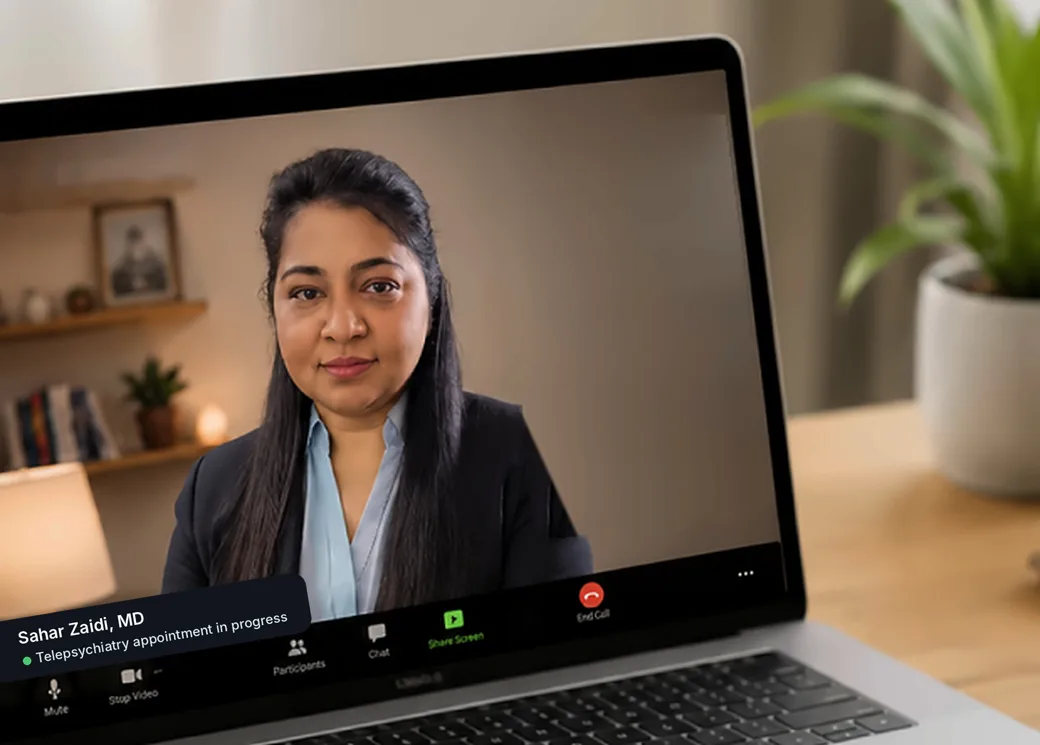
Sahar Zaidi, MD, on a laptop screen during a video visit

Video visits

Secure, HIPAA-compliant video visits for children, teens and adults who are in Virginia or Maryland during the appointment.

  • Your first evaluation can be by video.
  • A parent or guardian joins children’s video visits.
  • Join from a private place, not while driving.
  • Video visits aren’t available while you’re in D.C.

Plans accepted

  • Cigna
  • Aetna
  • BCBS
  • Anthem
  • CareFirst
  • UHC
  • Optum
  • UMR
  • Anthem BCBS FEP

Insurance and payment

Integral Psychiatric Care accepts Cigna, Aetna, BCBS, Anthem, CareFirst, UHC, Optum, UMR and Anthem BCBS FEP (Federal Employee Program), plus some other plans.

Self-pay is available, and superbills may help with out-of-network reimbursement.

Medicare and Medicaid are not accepted.

Coverage varies by plan, including for video visits. Please confirm your benefits with your insurer.

FAQs

Questions about bipolar disorder care

Grouped by who, or what, the question is about.

Prefer to speak with our intake team?

My child or teen

Can children have bipolar disorder?

Yes, though it is harder to diagnose in children.[6] A careful evaluation by a professional trained in child mental health comes first.[7] Signs overlap with ADHD, DMDD and other conditions, so the evaluation looks at patterns over time.[3]

Integral Psychiatric Care sees children from age 5, and a parent or guardian joins every visit for ages 5 to 17.

Is my child’s irritability a sign of bipolar disorder?

Not by itself. Irritability is common in several childhood conditions, including ADHD, DMDD and depression.[3] Bipolar disorder involves distinct episodes, with changes in energy, sleep and activity that are clearly different from the child’s usual self.[3]

How can we help our teen?

Help begins with an accurate diagnosis and treatment, and steady treatment works better than treatment that starts and stops.[3] Keep routines for sleep and meals, and take any talk of suicide seriously.[1][3] If you’re worried about your teen’s safety, call or text 988, or call 911 in an emergency.

Mood episodes

How long do manic and depressive episodes last?

Mania lasts at least a week, and hypomania at least four days.[2] Episodes cause symptoms most of the day for a week or two, or sometimes longer.[1] Without treatment, episodes often last from a few weeks to 6 months.[4]

What is rapid cycling?

Rapid cycling means having 4 or more mood episodes in a year.[4] Antidepressants used alone can trigger it, which is one reason they are used with care in bipolar disorder.[1]

What should we do if mania or severe depression starts?

If you’re having thoughts of suicide or of harming yourself, call or text 988 now, or call 911 if you’re in immediate danger.

If someone is in danger because of their behavior, call 911 or go to the nearest emergency room. For early signs of a new episode, contact your provider early, before it builds.[4]

Treatment

Can bipolar disorder be cured?

Bipolar disorder is a lifelong condition, and long-term, ongoing treatment can help manage symptoms.[1] Without treatment, episodes return in almost everyone.[4] Many people stay well for long periods with steady care.

Can bipolar disorder be treated without medication?

Some people may improve without medication, but there is no way to predict who.[6] For most people, the benefits of medicine outweigh the risks, and therapy works alongside medicine rather than replacing it.[6] Your provider talks through the options with you.

Will I need blood tests?

Some bipolar medicines need regular blood tests to check levels and side effects. Some lab tests are ordered by the practice, and others are arranged through your primary care provider. Your provider explains which tests apply to your plan and how often.

Do I need a psychiatrist for bipolar disorder, and can I keep my therapist?

A psychiatrist is a medical doctor who can diagnose bipolar disorder, look for other causes, and prescribe and monitor medicine. You can keep a therapist you already see, and with your consent, care is coordinated.

Everyone

Is bipolar disorder genetic?

Bipolar disorder runs in families, but a family history doesn’t mean someone will develop it.[6] Most people with bipolar disorder have a relative with bipolar disorder or depression.[2] Tell your provider about family history at the evaluation.[6]

What is the difference between bipolar disorder and borderline personality disorder?

Both involve big changes in mood. In borderline personality disorder, moods shift quickly with stress and usually last hours to a few days.[5] In bipolar disorder, moods last longer and come with changes in energy and activity, and the evaluation looks at which pattern fits.[5]

Can bipolar disorder be treated by video?

Yes. Evaluations and follow-up visits, including medication management, can be by video while you are physically in Virginia or Maryland. Video visits are limited to Virginia and Maryland because Sahar Zaidi, MD is licensed to practice medicine in those two states.

D.C. residents can be seen in person in Reston. Join from a private place, not while driving. Telepsychiatry: video visits in Virginia and Maryland ›

Request an appointment

Talk with us about bipolar disorder

Request an evaluation for yourself, your teen or your child. Our intake team will reach out to talk through next steps and scheduling.

Prefer to call? Talk with our intake team at 703-991-0564.

Your information is kept confidential. The limits, such as safety concerns, are explained at the first visit.

  • Appointments703-991-0564
  • Billing703-783-4620
  • Fax866-526-7323
  • Emailadmin@integralpsychiatriccare.com
  • Office1768 Business Center Drive, Suite 360, Reston, VA 20190
  • HoursMon–Fri, 8:30 a.m.–5:30 p.m., by appointment only. No walk-in appointments. Closed Saturday, Sunday and all major holidays.

All fields are required. Requesting care for your child or someone else? Enter your own details and mention who the appointment is for.

This form is not for emergencies. If you or someone else is in crisis, call or text 988, or call 911.

Sending a request does not confirm an appointment. Our intake team will contact you by phone, or by email if you prefer.

Sent through a secure, HIPAA-compliant form. Your information is used only to respond to your request. See our Privacy Policy.

Learn more

Medical disclaimer. This page is for general education and is not a substitute for professional medical advice, diagnosis or treatment.

References 7 sources

  1. National Institute of Mental Health. Bipolar Disorder. NIH Publication No. 25-MH-8088, revised 2025. nimh.nih.gov
  2. American Psychiatric Association. What Are Bipolar Disorders? Physician review April 2024. psychiatry.org
  3. National Institute of Mental Health. Bipolar Disorder in Children and Teens. NIH Publication No. 23-MH-8081, revised 2023. nimh.nih.gov
  4. Coryell W. Bipolar Disorders. MSD Manual Consumer Version, full review January 2026. msdmanuals.com
  5. Zimmerman M. Borderline Personality Disorder (BPD). MSD Manual Professional Version, full review September 2023, last updated January 2026. msdmanuals.com
  6. American Psychiatric Association. Expert Q&A: Bipolar Disorder. Accessed November 2026. psychiatry.org
  7. American Academy of Child and Adolescent Psychiatry. Bipolar Disorder in Children and Teens. Facts for Families No. 38, updated March 2017. aacap.org

✳   In Their Words

Experiences From the People
We Care For

Start your journey to lasting mental wellness with personalized, evidence based psychiatric care for all ages.

Join families and individuals who trust Integral Psychiatric Care for expert, compassionate psychiatric support.

K. L.
2 reviews

November 2026

“Dr. Zaidi immediately understood what my son, who is autistic, needed and knew how to help him. She has years of medical and specialty training, along with an extraordinary bedside manner. She is thorough, patient, and …”

G   Posted on
        Google

C. P.
5 reviews

May 2026

"Dr. Zaidi is a great Doctor. She always listens very carefully and provides insights and recommendations with honesty and professionalism. She makes sure to follow through with what is needed to improve the health of the patient and in a …"

G   Posted on
        Google