
Therapy and skills
CBT is the most-studied therapy for anxiety and panic.[3] CBT skills, DBT skills, and individual, family and supportive therapy are offered here. You can keep a therapist you already see; with your consent, care is coordinated.
Anxiety & Stress
Medically reviewed by Sahar Zaidi, MD, double board-certified in adult and child & adolescent psychiatry · Reviewed October 10, 2026
Including panic attacks and stress after a hard life change
People who come to us with anxiety often describe worry they can’t switch off, dread before a meeting or a school day, a sudden rush of fear with a pounding heart, or stress after a big change that hasn’t eased. Parents often notice stomachaches, clinging or not wanting to go to school first.
Integral Psychiatric Care evaluates and treats anxiety, panic and stress-related conditions in person in Reston, Virginia, and by video in Virginia and Maryland.
After you send a request, our intake team will reach out to talk through next steps and scheduling.
Evaluation first, then therapy, medication or both, decided with you. You don’t need a diagnosis or a referral to ask.


Double board-certified: Adult and Child & Adolescent Psychiatry
Washingtonian Top Doctor, Psychiatry, 2024 and 2025
What anxiety is
Everyday worry usually fits the situation and passes. An anxiety disorder is more persistent and harder to control, and it starts to affect relationships, work, school or well-being.[2]
Anxiety disorders are among the most common mental health conditions. Up to one in three people may have one at some point in life.[2]
Anxiety is felt in the body as well as the mind. Tension, headaches, stomachaches, a racing heart, feeling out of breath and poor sleep often come with it.[1]
Recognizing these is a reason to ask, not a diagnosis.
Worry about everyday things, such as work, health, money or family, that is hard to control, often with tension, tiredness or poor sleep.[1]
Frequent, unexpected panic attacks, with worry about the next one or avoiding places where attacks happened.[3] More about panic ›
An intense fear of being judged, embarrassed or rejected when speaking up, meeting people or performing.[2]
Strong fear of one thing or situation, such as heights, flying or needles. The person knows the fear is excessive, yet it still feels overwhelming.[2]
Excessive fear of being apart from parents or other close people. It is best known in children and can also affect adults.[2]
Fear of situations where escape or help might be hard, such as crowds, public transport or being outside the home alone.[2]
Obsessive thoughts and trauma-related anxiety have their own pages: OCD & Intrusive Thoughts › · Trauma & PTSD ›
Signs by age
Anxiety doesn’t look the same at every age. Adults often describe worry they can’t switch off, teens may show it through avoidance or irritability, and young children often show it through their bodies and behavior. Choose an age group to see common signs.
Notice when the worries or body complaints show up and what seems to set them off, and bring those notes to the evaluation. If anxiety becomes severe or starts to get in the way of school, friends or family life, ask for an evaluation.[6] For younger children, a parent’s part in treatment is essential.[6]
Panic and body symptoms
A panic attack is a sudden episode of intense fear with strong physical symptoms. Panic disorder means frequent, unexpected attacks, along with worry about the next one or avoiding places where attacks have happened.[3]
Panic disorder often begins in the late teens or early adulthood. Some people also develop agoraphobia: a fear of places where escape or help might be hard to get during an attack.[3]
Outside of panic attacks, anxiety can also show up as muscle tension, headaches, stomachaches, sweating, feeling lightheaded or out of breath, and frequent trips to the bathroom.[1] These symptoms are real. Because some medical conditions cause the same symptoms, the first step is often a check with a medical provider to rule them out.[1][2]
Panic disorder and physical anxiety symptoms are treated with therapy, such as cognitive behavioral therapy (CBT), medication, or both. Both can take some time to work.[3] How anxiety is treated ›
Stress and adjustment
Stress is a response to an outside cause, such as work pressure, schoolwork or an illness, and it usually goes away once the situation is resolved. Anxiety can continue even when there is no current threat.[4]
| Question | Everyday stress | Adjustment disorder | Anxiety disorder |
|---|---|---|---|
| What starts it | An outside pressure, such as work or an illness[4] | A stressful event or change, such as a job loss or becoming a parent[5] | Can continue without a current threat[4] |
| When it starts and how long it lasts | Goes away once the situation is resolved[4] | Starts within 3 months of the stressor; doesn’t last more than 6 months after it ends[5] | Persistent; can last months or years[1] |
| How much it gets in the way | Can cost some sleep, then eases | Distress out of proportion to the event, or trouble at work, school or home[5] | Harder to control; affects relationships, work or well-being[2] |
Emotional or behavioral symptoms, such as anxiety, low mood or acting out, that start within 3 months of a stressor. The stressor can be one event, such as losing a job; several, such as money problems followed by a breakup; an ongoing strain, such as caring for a family member with a disability; or even a happy milestone, such as becoming a parent.[5]
Care starts with the same evaluation, which also looks for anything underneath, such as an anxiety disorder, depression or a sleep problem. Treatment may include supportive therapy or CBT, and medication for specific symptoms such as poor sleep or anxiety when it fits.[5] A steady sleep routine, regular exercise and time with supportive people help too.[4]
It’s time to ask for help when stress or anxiety won’t go away, or gets in the way of everyday life.[4]
Many people call long-running work stress “burnout.” Burnout is an everyday word, not a diagnosis, and the evaluation looks at what may be underneath it. Stress after a frightening or life-threatening event is covered on Trauma & PTSD ›
How it’s diagnosed
Anxiety is diagnosed through a psychiatric evaluation, a conversation about your symptoms, history and daily life, not a single test. A physical exam may also be suggested to make sure an unrelated physical problem isn’t causing the symptoms.[1]
Send a request or call 703-991-0564. Our intake team talks through what’s going on, your insurance and scheduling.
In person in Reston or by secure video. Your provider asks when the worry, fear or attacks started, what makes them better or worse, and about sleep, mood, health, caffeine, alcohol and other substances, medicines and earlier treatment. A parent or guardian joins every visit for ages 5 to 17, and adults are welcome to bring a family member or partner.
Your provider considers conditions that can look like anxiety or occur with it, and medical causes that may need a check with your primary care provider.[2]
Toward the end of the visit, your provider explains the findings in plain language and shares a first plan, decided together. If it isn’t anxiety, your provider explains what the evaluation found and discusses care for that, or other next steps.
You don’t need to be sure it’s anxiety; finding out is what the evaluation is for. Integral Psychiatric Care doesn’t require a referral, though some insurance plans do. You can upload earlier records and a list of your medicines to your patient portal before the visit.
| It may be | How it can differ |
|---|---|
| Depression | Low mood and loss of interest lead. Depression and anxiety often occur together. |
| ADHD | Restlessness and trouble concentrating that began in childhood and show up even without worry. |
| Sleep problems | Poor sleep can feed worry, and worry can disturb sleep. |
| OCD | Unwanted, repeated thoughts and urges to do rituals, rather than general worry. |
| Trauma or PTSD | Fear, avoidance and feeling on edge that began after a frightening event. |
| A medical cause or substance | Some health problems, medicines or substances can cause similar symptoms.[2] |
Treatment
Anxiety is usually treated with therapy, medication or both.[1] Which fits depends on how much the anxiety gets in the way, what has been tried and your preferences. The plan is decided together after the evaluation, and the reason for any medicine is explained.
| Situation | Where treatment usually starts |
|---|---|
| Milder anxiety, at any age | Therapy alone, such as CBT, can work well.[2] |
| Moderate to severe anxiety in adults | Therapy, medication or both. Certain antidepressants (SSRIs and SNRIs) are first-line medicines for many anxiety disorders.[2] |
| Moderate to severe anxiety in children and teens | Medication can be appropriate for children as well as adults.[2] The plan is made with the parent or guardian, who is part of treatment.[6] |
Antidepressants carry an FDA boxed warning about suicidal thoughts and behavior in children, teens and young adults under 25, so anyone starting one is watched closely.[7] Antidepressants and young people ›
CBT is the most-studied therapy for anxiety and panic.[3] CBT skills, DBT skills, and individual, family and supportive therapy are offered here. You can keep a therapist you already see; with your consent, care is coordinated.
At the evaluation, your provider reviews each medicine you take now and may continue it, adjust the dose, or stop it and prescribe a different one. Please talk with your provider before stopping any medicine.
The first follow-up is usually about 2 to 3 weeks after the evaluation. As symptoms improve and things are stable, visits are usually spaced to every 1 to 2 months.
Tell your provider. Therapy and medication can both take some time to work.[3] Your provider first checks practical things, such as sleep, caffeine, new stress and whether medicine is taken as prescribed, and whether the diagnosis still fits. Then the plan changes, decided together.
Some people need more support than outpatient visits can give. When that happens, Integral Psychiatric Care refers them to a more intensive program, such as intensive outpatient or partial hospitalization.
Choose the description closest to where you are now. If you aren’t sure, start with an evaluation.

Meet Dr. Zaidi
Founder and Medical Director
Dr. Zaidi evaluates and treats children, teens and adults. Because she treats all three, she sees how anxiety can change from one stage of life to the next.
Visit options
Choose an in-person visit at the Reston office or a secure video visit. Our intake team can walk you through visit options and insurance before your first appointment.

1768 Business Center Drive, Suite 360, Reston, VA 20190
Mon–Fri, 8:30 a.m.–5:30 p.m., by appointment only. No walk-in appointments. Closed Saturday, Sunday and all major holidays.
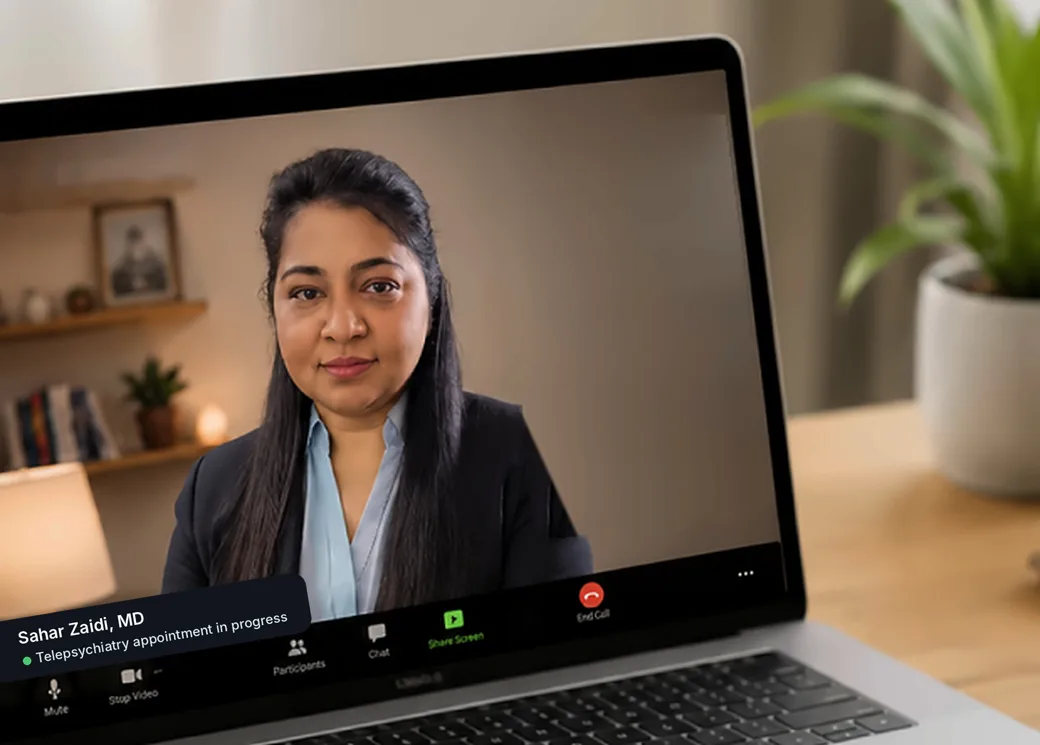
Secure, HIPAA-compliant video visits for children, teens and adults who are in Virginia or Maryland during the appointment.
Plans accepted
Integral Psychiatric Care accepts Cigna, Aetna, BCBS, Anthem, CareFirst, UHC, Optum, UMR and Anthem BCBS FEP (Federal Employee Program), plus some other plans.
Self-pay is available, and superbills may help with out-of-network reimbursement.
Medicare and Medicaid are not accepted.
Coverage varies by plan, including for video visits. Please confirm your benefits with your insurer.
Questions about coverage?
703-991-0564
Billing questions: 703-783-4620
FAQs
Grouped by who, or what, the question is about.
Integral Psychiatric Care sees children from age 5. A parent or guardian joins every visit for ages 5 to 17, in person and by video, and the child must be in Virginia or Maryland during a video visit. You and your child or teen each get some time with the provider on your own.
Not necessarily. Therapy alone can work for milder anxiety, and medication can be appropriate for moderate to severe anxiety in children as well as adults.[2] The decision is made together with you after the evaluation, the risks and benefits are explained first, and any medicine is reviewed at regular follow-up visits.
Yes. Refusing to go to school can be a sign of anxiety in children.[6] The evaluation looks at what is behind it, and treatment can include skills your child practices at home and at school, with you involved. With your consent, your child’s provider can coordinate with the school.
You can’t tell for sure on your own. Anxiety can make you feel out of breath,[1] but heart and lung problems can too. If it’s new or severe, or comes with chest pain or fainting, call 911. If it keeps coming back, see a medical provider first. Once physical causes are ruled out, an anxiety evaluation can look at the pattern.
It varies. Antidepressants used for anxiety may take several weeks to start working,[1] and therapy skills take practice before they feel natural. Your provider checks progress at follow-up visits. No one can promise how quickly a particular treatment will help.
You can. It’s time to ask when stress or anxiety won’t go away, or gets in the way of everyday life.[4] The evaluation looks for anything underneath the stress, such as an anxiety disorder, depression, a sleep problem or an adjustment disorder, and treatment follows what it finds.
Yes. Anxiety and depression often occur together, and the evaluation looks at both. When both are present, one plan covers both, with therapy, medication when it fits, and follow-up visits to check how each is responding.
Yes. Integral Psychiatric Care offers medication management and therapy in one practice, including CBT skills, DBT skills, and individual, family and supportive therapy. Both are part of one plan, reviewed at the same follow-up visits.
It depends on how much the anxiety gets in the way. A therapist provides talk therapy, which can be enough for milder anxiety.[2] A psychiatrist is a medical doctor who can diagnose anxiety, look for medical causes and other conditions, and prescribe and monitor medicine. At Integral Psychiatric Care, evaluation, medication and therapy are in one practice, so you don’t have to decide before the first visit.
Yes. Evaluations and follow-up visits, including medication management, can be by video while you are physically in Virginia or Maryland. Video visits are limited to Virginia and Maryland because Sahar Zaidi, MD is licensed in Virginia and Maryland. D.C. residents can be seen in person in Reston. Join from a private place, not while driving.
Integral Psychiatric Care accepts Cigna, Aetna, BCBS, Anthem, CareFirst, UHC, Optum, UMR and Anthem BCBS FEP. Benefits vary by plan, including for video visits, so please confirm coverage with your insurer before your appointment. Medicare and Medicaid are not accepted.
Request an appointment
Request an evaluation for yourself, your teen or your child. Our intake team will reach out to talk through next steps and scheduling.
Prefer to call? Talk with our intake team at 703-991-0564.
Your information is kept confidential. The limits, such as safety concerns, are explained at the first visit.
Sending a request does not confirm an appointment. Our intake team will contact you by phone, or by email if you prefer.
Sent through a secure, HIPAA-compliant form. Your information is used only to respond to your request. See our Privacy Policy.
Learn more
Outside resources on anxiety: National Institute of Mental Health: Anxiety Disorders · American Psychiatric Association: What Are Anxiety Disorders?
Medical disclaimer. This page is for general education and is not a substitute for professional medical advice, diagnosis or treatment.
✳ In Their Words
Start your journey to lasting mental wellness with personalized, evidence based psychiatric care for all ages.

Join families and individuals who trust Integral Psychiatric Care for expert, compassionate psychiatric support.
K. L.
2 reviews
November 2026
“Dr. Zaidi immediately understood what my son, who is autistic, needed and knew how to help him. She has years of medical and specialty training, along with an extraordinary bedside manner. She is thorough, patient, and …”
G Posted on
Google
C. P.
5 reviews
May 2026
"Dr. Zaidi is a great Doctor. She always listens very carefully and provides insights and recommendations with honesty and professionalism. She makes sure to follow through with what is needed to improve the health of the patient and in a …"
G Posted on
Google
Hear from others
See what people share about their experiences with Integral Psychiatric Care.
Integral Psychiatric Care uses cookies to operate this site and, with your permission, analyze usage and measure advertising performance. Manage your choices in Cookie settings or learn more in our Privacy Policy.
Choose which optional cookies we may use. You can change this at any time from "Cookie settings" at the bottom of every page. Learn more in our Privacy Policy.