Adult ADHD

Adult ADHD evaluation and treatment

Medically reviewed by Sahar Zaidi, MD, double board-certified in adult and child & adolescent psychiatry · Reviewed November 16, 2026

For adults ages 18 to 65, whether this is new or you’ve been treated before

Maybe you’ve wondered about ADHD for years. Deadlines slip, tasks are left half-done, and everyday things take more effort than they seem to for others. Or you were diagnosed as a child and need care to continue now.

Integral Psychiatric Care evaluates and treats ADHD in adults, in person in Reston, Virginia, and by video in Virginia and Maryland.

After you send a request, our intake team will reach out to talk through next steps and scheduling.

Evaluation first, then a plan decided with you. You don’t need an earlier diagnosis or test results to ask for an evaluation.

A smiling woman in a yellow jacket with her arms open on a green hillside

Double board-certified: Adult and Child & Adolescent Psychiatry

Washingtonian Top Doctor, Psychiatry, 2024 and 2025

  • Accepting new patients, ages 5 to 65
  • In person in Reston, or by video in Virginia and Maryland
  • No referral required by Integral Psychiatric Care
Who we see
Adults 18 to 65
First step
Initial psychiatric evaluation
Visit options
In person in Reston
Payment
Insurance or self-pay

Adults and ADHD

Can adults have ADHD, and can it start in adulthood?

Yes, adults can have ADHD. In a national survey published in 2024, about 6% of U.S. adults, or 15.5 million people, reported a current ADHD diagnosis. More than half of them were first diagnosed as adults.[1]

ADHD symptoms begin in childhood, but many adults also have ADHD, and the symptoms may change with age.[2]

The American Psychiatric Association notes that hyperactivity in adults can show up as extreme restlessness, while inattention may persist. Symptoms can also become harder to manage as the demands of adult life grow.

Can ADHD start in adulthood?

For a diagnosis, several symptoms need to have been present before age 12.[2] Later-onset ADHD has been proposed, but more research is needed, and it isn’t part of the current diagnostic criteria.[4]

Many children with ADHD go undiagnosed, according to the American Psychiatric Association, so the evaluation looks back at childhood as well as at today.

Signs in adult life

What does ADHD look like in adults?

Everyone is forgetful or distracted at times. In ADHD, symptoms are more severe, frequent and persistent, and they interfere with daily life.[2] The American Psychiatric Association notes that they show up in more than one setting, such as work and home. Here is how that can look day to day.

At work

Missing details, losing track of long tasks, or putting off work until the last minute.

At home and with money

Bills paid late, mail left unopened, keys misplaced, or chores left half-done.

With time

Underestimating how long things take, running late, or losing track of appointments.

In relationships

Drifting off in the middle of a conversation, interrupting, forgetting plans, or acting on impulse.

A hard stretch, or a lifelong pattern?

Stress or a busy season can make anyone forgetful for a while. ADHD symptoms begin in childhood, which is why the evaluation looks at your history as well as how things are now.[2]

No quiz decides this

A checklist can prompt the question. Diagnosing ADHD in adults requires a full clinical history and evaluation.[4]

ADHD or something else

Could it be something other than ADHD?

Yes. Sleep disorders, anxiety, depression and other physical conditions or illnesses can cause symptoms similar to ADHD.[3] Part of the evaluation is looking at what else could explain what you notice.

What can look like ADHD in adults, or come with it
It may beWhat to know
AnxietyAnxiety can cause symptoms similar to ADHD, and the two can also occur together.[3][4]
DepressionDepression can cause symptoms similar to ADHD, and the two can also occur together.[3][4]
Sleep disordersSleep disorders can cause symptoms similar to ADHD.[3] Sleep problems are also common in adults with ADHD, affecting up to 70%.[2]
Other health problemsSome physical conditions and illnesses can cause similar symptoms.[3] The evaluation asks about your health and the medicines you take.

If it isn't ADHD

If it turns out not to be ADHD, your provider explains what the evaluation found and discusses care for that, or other next steps.

ADHD in adults often occurs with other conditions, such as anxiety, mood or personality disorders.[4] One diagnosis doesn’t rule out another, so the evaluation looks at the whole picture.

How it’s evaluated

How is ADHD evaluated in adults?

Diagnosing ADHD in adults requires a full clinical history and evaluation.[4] Because symptoms begin in childhood, the evaluation relies heavily on past reports of behavior as well as on how things are now.[2]

  1. Request and intake

    Send a request or call 703-991-0564. Our intake team talks through what’s going on, your insurance and scheduling.

  2. Your initial psychiatric evaluation

    In person in Reston or by secure video. Your provider asks about attention, organization, restlessness and impulsivity, and how they affect work, home and relationships. You’ll also talk about health, sleep, mood and the medicines you take.

  3. A look back at childhood

    Your provider asks what you remember about school and growing up. Old school reports can help if you have them.[2] It’s fine if you don’t.

  4. Input from someone who knew you

    A partner or family member can take part, or share input on your childhood history, once you sign a release of information (ROI) form for that person.

  5. Findings and a first plan

    Your provider may ask you to complete an ADHD questionnaire, which our team sends you. Toward the end of the evaluation, your provider explains the findings in plain language and shares a preliminary plan, decided together.

You don't need proof to start

You don’t need an earlier diagnosis or test results; finding out is what the evaluation is for. Integral Psychiatric Care doesn’t require a referral, though some insurance plans do. You can upload earlier records and a list of your medicines to your patient portal before the visit.

Do I need a test?

Formal psychological testing isn’t required to diagnose ADHD, but it can help when learning or other questions need a closer look. If it would help, your provider will talk with you about options.

When formal psychological testing is needed, it’s done by a psychologist outside the practice.

Testing may help when childhood history and reports from other people are hard to get.[4]

Treatment

How is ADHD treated in adults?

Treatment for ADHD can reduce symptoms and improve functioning, and effective treatment often combines several elements.[2] For adults, that can mean medicine, therapy and skills, and changes to everyday routines. The plan is decided together after the evaluation, and the reason for any medicine is explained.

Medication, when it fits

Medicines for ADHD fall into two groups: stimulant and non-stimulant medicines. Non-stimulants are an option when stimulants aren’t a good fit, for example when they don’t help or aren’t tolerated.[4]

Your provider explains the reason for any medicine and checks how it’s working at follow-up visits.

Therapy and skills

Cognitive behavioral therapy (CBT) is recommended for adults with ADHD, and medicine may work better when combined with therapy.[4]

CBT skills, DBT skills, and individual, family and supportive therapy are offered here. You can keep a therapist you already see; with your consent, care is coordinated.

Everyday strategies

The National Institute of Mental Health suggests a few habits. Stick to a consistent routine, write down appointments and reminders, and break large tasks into smaller, more manageable steps.[3]

Your provider can talk through which ones fit your work and home life.

If you'd rather not take medicine

Tell your provider. Therapy, skills and everyday strategies are part of treatment with or without medicine, and the choice is made with you.

Your provider explains what the evaluation suggests about each option, so you can decide with the full picture.

Continuing care

Already taking ADHD medicine, or moving your care here?

Care starts with an initial psychiatric evaluation, even if you’ve been treated for ADHD before.

At the evaluation, your provider reviews each medicine you take now and may continue it, adjust the dose, or stop it and prescribe a different one.

An earlier assessment may be repeated. Your provider may ask you to complete an ADHD questionnaire, which our team sends you.

You can upload earlier records, reports and a list of your medicines to your patient portal before the visit.

Diagnosed as a child?

Bring what you have, such as old reports or the name of the practice that diagnosed you. Symptoms can change with age, so your provider looks at how ADHD affects you now.[2]

The first follow-up is usually about 2 to 3 weeks after the evaluation. As symptoms improve and things are stable, visits are usually spaced to every 1 to 2 months.

Sahar Zaidi, MD, founder of Integral Psychiatric Care

Meet Dr. Zaidi

Sahar Zaidi, MD

Founder and Medical Director

Dr. Zaidi evaluates and treats children, teens and adults. Because she treats all three, she sees how ADHD can change from childhood into adult life.

  • Board-certified in Adult Psychiatry and Child & Adolescent Psychiatry
  • Diplomate, American Board of Psychiatry and Neurology
  • Child & Adolescent Psychiatry fellowship, University of Michigan, Ann Arbor
  • Washingtonian Top Doctor, Psychiatry, 2024 and 2025

What you can expect here

  • One practice for ages 5 to 65; a parent and a child can both be patients here
  • Evaluation, medication management and therapy in the same practice
  • A parent or guardian joins every visit for ages 5 to 17, and teens also get time on their own
  • With your consent, coordination with a school or other clinicians

Visit options

In-person care in Reston, video visits in Virginia and Maryland

Choose an in-person visit at the Reston office or a secure video visit. Our intake team can walk you through visit options and insurance before your first appointment.

A consultation room at the Reston office with a sofa, armchairs and a window

Reston office

1768 Business Center Drive, Suite 360, Reston, VA 20190

Mon–Fri, 8:30 a.m.–5:30 p.m., by appointment only. No walk-in appointments. Closed Saturday, Sunday and all major holidays.

Patients come from across Northern Virginia, including Herndon, Fairfax and Ashburn, and from Maryland communities such as Bethesda and Rockville. D.C. residents are welcome to be seen in person here.

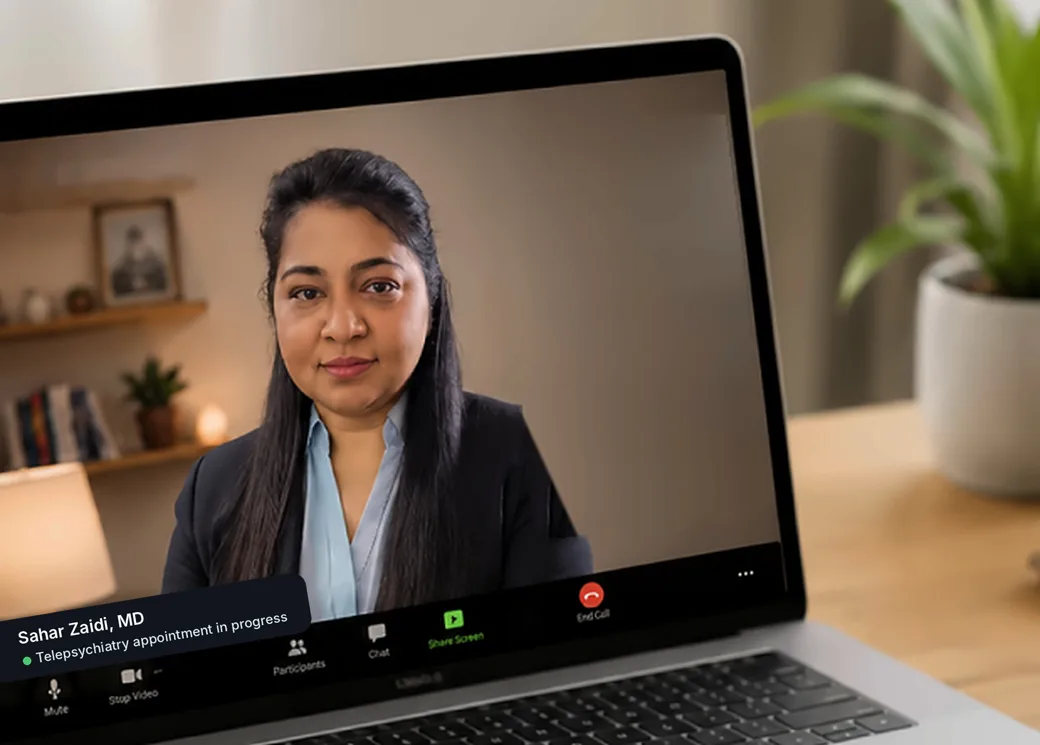
Sahar Zaidi, MD, on a laptop screen during a video visit

Video visits

Secure, HIPAA-compliant video visits for children, teens and adults who are in Virginia or Maryland during the appointment.

  • Your first evaluation can be by video.
  • A parent or guardian joins children’s video visits.
  • Join from a private place, not while driving.
  • Video visits aren’t available while you’re in D.C.

Plans accepted

  • Cigna
  • Aetna
  • BCBS
  • Anthem
  • CareFirst
  • UHC
  • Optum
  • UMR
  • Anthem BCBS FEP

Insurance and payment

Integral Psychiatric Care accepts Cigna, Aetna, BCBS, Anthem, CareFirst, UHC, Optum, UMR and Anthem BCBS FEP (Federal Employee Program), plus some other plans.

Self-pay is available, and superbills may help with out-of-network reimbursement.

Medicare and Medicaid are not accepted.

Coverage varies by plan, including for video visits. Please confirm your benefits with your insurer.

FAQs

Questions about adult ADHD care

Grouped by what the question is about.

Prefer to speak with our intake team?

The evaluation

What if I don’t have my school records?

You can still be evaluated. Records help, because diagnosis relies heavily on past reports of behavior, but they aren’t required.[2]

Your provider asks what you remember. A partner or family member can take part, or share input on your childhood history, once you sign a release of information (ROI) form for that person.

I was diagnosed as a child. Do I need a new evaluation?

Yes, care starts with an initial psychiatric evaluation. Symptoms can change with age, so your provider looks at how ADHD affects you now.[2]

An earlier assessment may be repeated. You can upload old reports to your patient portal before the visit.

Video visits

Can I do the whole evaluation by video?

Yes, your first evaluation can be by video while you are physically in Virginia or Maryland. Video visits are limited to Virginia and Maryland because Sahar Zaidi, MD is licensed to practice medicine in those two states.

In-person appointments are offered at our office in Reston, Virginia. Patients come for adult ADHD care from Fairfax, Loudoun, Arlington and Prince William counties, and from nearby Maryland communities such as Bethesda, Rockville and Silver Spring. Video visits are available while you are in Virginia or Maryland.

D.C. residents can be seen in person in Reston. Join from a private place, not while driving. Telepsychiatry: video visits in Virginia and Maryland ›


I’m at college in another state. Can I keep my video visits?

Video visits can take place only while you are physically in Virginia or Maryland. If you’ll be out of state at the time of a visit, it’s rescheduled.

Call 703-991-0564 at least 2 business days ahead to avoid a late rescheduling fee. You can also be seen in person in Reston when you’re back.

Treatment

Does treatment always mean medication?

No. Effective treatment often combines several elements, and therapy and skills can be part of it.[2][4] Whether medicine fits is decided together after the evaluation, and you can say if you’d rather not take it.

Practical questions

Can my partner come to the appointment?

Yes. Adults are welcome to bring a family member or partner.

A partner or family member can take part, or share input on your childhood history, once you sign a release of information (ROI) form for that person.

Will my employer find out?

Your records are confidential and shared only with your consent.

You’ll be treated with respect, and your information is kept confidential. The limits, such as safety concerns, are explained at the first visit.

Does insurance cover an adult ADHD evaluation?

ADHD evaluation and testing are usually covered by insurance. Please check with your insurance for confirmation. The plans Integral Psychiatric Care accepts are listed under Visit options.

Please note: Integral Psychiatric Care does not accept Medicare or Medicaid. Integral Psychiatric Care doesn’t require a referral, though some insurance plans do.

Request an appointment

Talk with us about adult ADHD

Request an evaluation for yourself. Our intake team will reach out to talk through next steps and scheduling.

Prefer to call? Talk with our intake team at 703-991-0564.

Your information is kept confidential. The limits, such as safety concerns, are explained at the first visit.

  • Appointments703-991-0564
  • Billing703-783-4620
  • Fax866-526-7323
  • Emailadmin@integralpsychiatriccare.com
  • Office1768 Business Center Drive, Suite 360, Reston, VA 20190
  • HoursMon–Fri, 8:30 a.m.–5:30 p.m., by appointment only. No walk-in appointments. Closed Saturday, Sunday and all major holidays.

All fields are required. Requesting care for your child or someone else? Enter your own details and mention who the appointment is for.

This form is not for emergencies. If you or someone else is in crisis, call or text 988, or call 911.

Sending a request does not confirm an appointment. Our intake team will contact you by phone, or by email if you prefer.

Sent through a secure, HIPAA-compliant form. Your information is used only to respond to your request. See our Privacy Policy.

Learn more

Medical disclaimer. This page is for general education and is not a substitute for professional medical advice, diagnosis or treatment.

References 4 sources

  1. Staley BS, et al. Attention-Deficit/Hyperactivity Disorder Diagnosis, Treatment, and Telehealth Use in Adults: National Center for Health Statistics Rapid Surveys System, United States, October to November 2023. MMWR. 2024;73(40):890–895. cdc.gov
  2. National Institute of Mental Health. ADHD in Adults: 4 Things to Know. NIH Publication No. 24-MH-3573, 2024. nimh.nih.gov
  3. National Institute of Mental Health. Attention-Deficit/Hyperactivity Disorder: What You Need to Know. NIH Publication No. 24-MH-8300, 2024. nimh.nih.gov
  4. Olagunju AE, Ghoddusi F. Attention-Deficit/Hyperactivity Disorder in Adults. American Family Physician. 2024;110(2):157-166. aafp.org

✳   In Their Words

Experiences From the People
We Care For

Start your journey to lasting mental wellness with personalized, evidence based psychiatric care for all ages.

Join families and individuals who trust Integral Psychiatric Care for expert, compassionate psychiatric support.

K. L.
2 reviews

November 2026

“Dr. Zaidi immediately understood what my son, who is autistic, needed and knew how to help him. She has years of medical and specialty training, along with an extraordinary bedside manner. She is thorough, patient, and …”

G   Posted on
        Google

C. P.
5 reviews

May 2026

"Dr. Zaidi is a great Doctor. She always listens very carefully and provides insights and recommendations with honesty and professionalism. She makes sure to follow through with what is needed to improve the health of the patient and in a …"

G   Posted on
        Google